
Episode 18
Thinking out loud about Genius Loci, Kitchens, Workshops, Desks, Mise en place and Knolling.
Magical Geography begins soon over on http://runesoup.com/ so sign up if it floats your boat!
Thanks this week to @ar7w1n and http://farmerversusfox.blog/ for long conversations about this over the years.
You can subscribe to Permanently Moved in itunes: permanentlymoved.online/itunes or search in all your favourite podcatchers.
Permanently moved is a personal podcast 301 seconds in length, written and recorded in one hour by @thejaymo
301 // Permanently Moved
Show Supporter 📻
Support the Show
Quarterly zine; my gift to you.
Mise en place
So one of the things that’s coming up this quarter in runesoup.com’s premium members section is a new course on magical geography. If that’s the sort of thing that interests you, then I definitely recommend going over there and signing up for the 10 bucks a month and diving straight in. But because the course hasn’t started yet, I thought I’d get some of my own thoughts down in audio and maybe revisit them once the course is completed and see if I’ve changed my mind about anything.
Don’t worry if that’s the sort of thing that doesn’t interest you, as I’m not going to be talking about magical wells. Instead, I’m going to be talking about kitchens.
First, some of my favourite places to visit are working workshops and studios of artists and artisans. And I think a lot of other people do.
I mean, I think there’s a reason why Casey Neistat’s studio tour videos regularly crack up 3, 4, 5 million views on YouTube.
Because these spaces are inhabited functional spaces. So let’s analyze them just for a little bit.
These spaces are bounded by their geography. This means how wide the walls are apart, how high the ceilings are, and just how much stuff can you fit in it. What can you bring in? What do you have to build inside? What can be taken out? Some places, like metalworking studios or forges, have fixed elements that cannot be moved. And in fact, sometimes we’re placed there to consider the prevailing winds outside of the building.
So you have these spaces that you can enter, and spend a lot of time inside. Through doing so, you relate to the space. You get to know it, it becomes familiar to you, and because of the layout of the place, it begins to develop a personality. And the placement of certain objects within the space is a negotiation between you and the personality of the space that you’re in.
We keep these storage boxes over here by the door, all these nails and screws live in boxes labeled above the workbench. Some of these locations have the people who are inhabiting the space. Like when you go back to your parents house and you’re looking for something and you open a drawer and you think, why on earth is all of this stuff here?
Or think about the personality of a highly trafficked part of your house. Might be a hallway, or a doorway, but regardless, because it’s highly trafficked, it’s also frequently cleaned. But I know. That you know that there is a little corner tucked away somewhere that is full of dust bunnies, and you see it every time you walk through that particular space.
It has nothing to do with how often you clean, but the personality of the space is that’s where the dust bunnies collect. So in some sense then, you are in relation or negotiation with the space. At some point, an asshole boss has probably said to you, Tidy desk, tidy mind. But that’s a load of bollocks, because what it should be is a well negotiated space results in a better relationship between you and the environment within which you can carry out tasks.
Which isn’t as pithy or memorable, I’ll admit. And just because it turns out that some of these spaces are tidy, Doesn’t necessarily follow that yours needs to be under certain negotiated conditions I’m sure we all know people with offices or desks with papers piled up high but they know where absolutely Everything is or which book is under which pile on which bookshelf and let me be clear i’m talking about working spaces here.
Tidy your room. No excuses.
Consider spaces that are inherited. I was lucky enough to go on the Whitechapel Bell Foundry tour before it closed. This is a workshop that had been in use for 500 years. And one of my questions was, why is anything where it is? I asked about some buckets, and he said, “Well, that’s where we’ve always kept them, ever since I was a boy.”
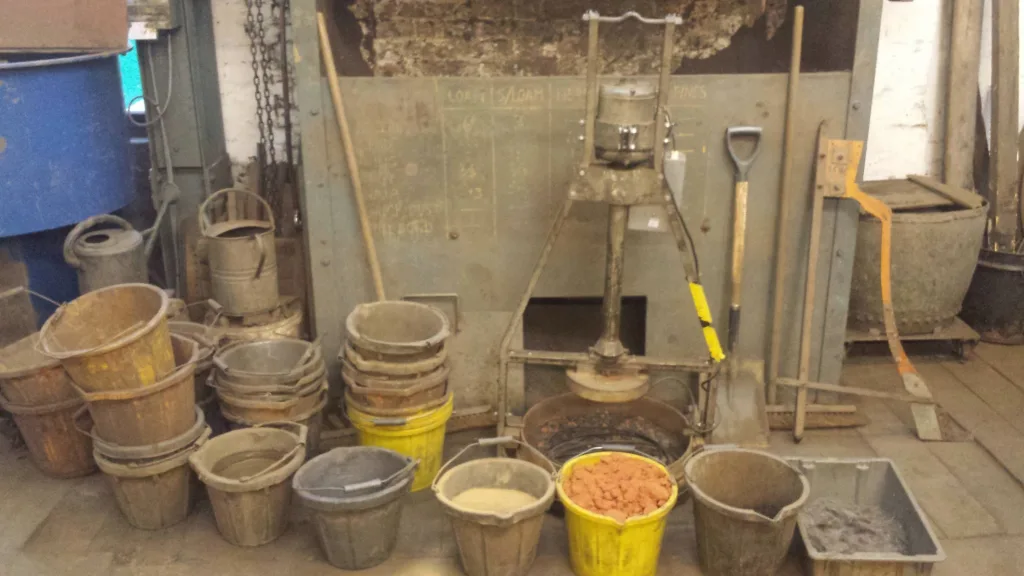
But he thought about it for a little longer, and then stepped, and stepped again, and then said, “Well, these buckets are no less than five steps from anywhere where you might need a bucket.”
And that seems obvious when you think about it, but it is my contention to you that the space dictated where the bucket should be kept, not where the individual people who were working in the space Which brings me on to the subject of the French term mise en place.
A chef’s term for everything has its place. The layout of your tools before you begin a task.
The popular internet term of knolling also falls into this category. Have you ever walked into someone’s kitchen who cooks a lot? And known exactly where the knives were kept, or that the bowls were in this particular cupboard, it was the kitchen that told you where they were.
Take a moment and think about it next time it happens to you. And it’s always surprising. Or next time you’re working at your desk or workbench, and you lean your hand out and pick something up without looking at it, and go back to your work. A subconscious act. Because somewhere, You had negotiated with the place to keep it there.
And of course there’s more to say on this stuff about why you have favourite pens or why certain tools develop personalities. But that’s for another day.
Permanently Moved
Permanently Moved is a 301-second personal podcast, written, recorded, and edited by @thejaymo.