

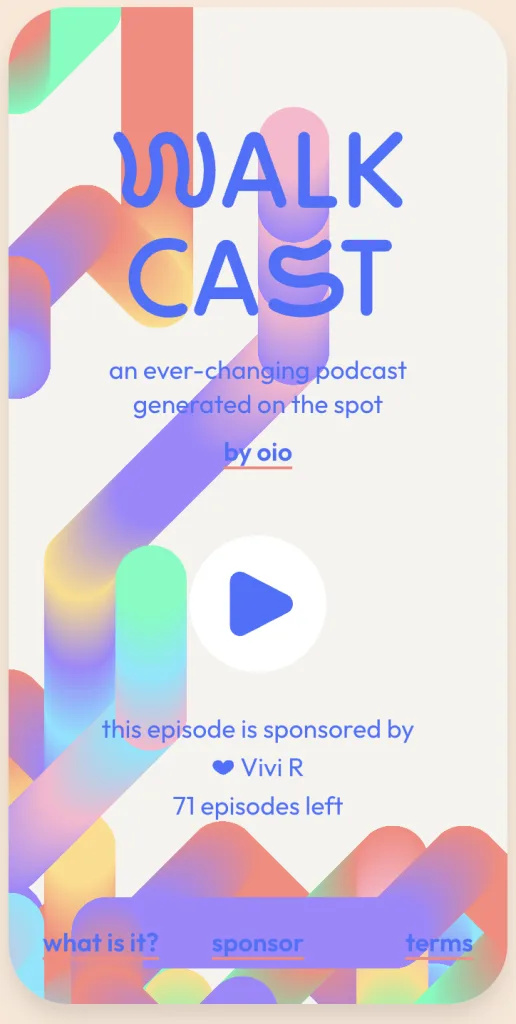
I tried out a new App called WalkCast today developed by oio studio.
They bill it as a “Story Telling Engine,” which is definitely more snappy than saying it’s an: AI powered – location based – narrative non fiction – podcast generator?
It’s quite a fun little app. I’m reposting their marketing video below, as I can’t seem to link directly to it:
How it Works
The app grabs your location, searches the web for information about where you are, generates a narrative text summary, and spits it out as audio. On the about page, they hint that there’s a lot more happening behind the scenes, but essentially that’s the experience.
Imagine it as a series of intelligent agents—curator, editor, and host—each with a distinct role in the creation of every story. The curator digs deep into your surroundings, finding facts and points of interest. The editor weaves these into a dynamic script, sometimes adding creative tangents and surprising twists.
Finally, the host—our AI-generated voice—delivers the story, always in the perfect tone. This loop continues as long as you keep walking, transforming every step into a suprising moment.
In the end, here at oio we’re on a mission to create products and tools for a less-boring future, and waiting for someone else to do it just wasn’t an option. So we built it ourselves.
I recently made an episode of 301 about Googles NotebookLM where I self inserted an AI version of my own voice into the ‘podcast’ it generated about my own work. I’ve also written about the weird issues that we are going to have to confront in the medium term.
But never the less, personality driven front ends for AI systems are an emerging UX paradigm and and WalkCast fits right into that space and have made something quite compelling. But having tried it, I also have some problems with it.
My Immediate Challanges
I went for a walk with the app this morning and experienced it twice (each session lasting about 7–10 minutes). The best way to describe it is that it felt like being ‘inside Wikipedia.’ The infosphere was narratively augmented over my direct physical environment.
For the first five minutes or so, it really does feel like a Location-Specific Experience. But as you continue to use the app, the narrative presentation about the place you’re in starts to feel flat.
One issue was the repetitive structure of the narratives. Each experience followed the same pattern: first, some facts about the immediate location, then a zoom-out to a broader area, followed by a tenuous metaphor. For example, I listened to a story about Seething Wells that morphed into a spooky ghost tale, which then swerved into an NPR-style metaphor about jellyfish (yes, jellyfish!) and tunnels, before zooming out to Surbiton and ending with another odd connection to fungi and arts and crafts. It was weirdly disjointed.
This brings up a bigger issue: narrative nonfiction ≠ story. A good story has structure, pacing, and a sense of direction, but WalkCast lacks that. There’s no feedback loop responding to the user’s actions or movement. Even museum audio guides provide more agency than this app by letting listeners control what they hear and when. I was expecting something more interactive—perhaps a ‘choose your own adventure’ vibe, where the app could suggest going left to learn about X or right to hear about Y.
Spatial Storytelling
My friend Rob Morgan has a book coming out in December on CRC Press: Storytelling for Spatial Computing and Mixed Reality: The Art of Augmenting Imagination. In the interests of full disclosure I have a blurb on the jacket:
A vision for storytelling in the coming age of spatial computing. Offering a mix of practical guidance and speculative theory, Morgan equips readers for the narrative possibilities ahead. A primer and a gateway to next-gen storytelling in virtual worlds of all kinds.
Jay Springett – Researcher & Worldrunner
Rob began his career working in VR and more recently in location-based augmented reality theatre with his company Playlines. I’ve been very fortunate to have read several drafts of his book over the last year and as a result, can only really think of WalkCast though the lens of his work. Which is difficult as I want to quote so much from it as the book isn’t out yet!
Rob spends a great deal of the book discussing AUGMENTING PLACES (Section 4) and explaining the different design philosophies of Augmented Location-Agnostic Experiences and Location-Specific Experiences as well as another he calls ‘location-portable‘. Its all too much detail to go into but there are a couple of things that come to mind.
It’s tempting to say that WalkCast have made a Location-Specific Experience. After all you fire up the app and find yourself immersed in the infospehere of the place around you. Satisfying Gordon Calleja’s insistence that to create ‘immersion’ the techno-social system must “acknowledgement of the player’s location and presence.” (I’ve written about Calleja’s work here).
Improvements
One of the key elements of augmented/spatial narrative design is that is that the audience is not just a witness to the narrative but are inside of it. WalkCast fails because there’s no story to be inside of, there’s no sequence of events, no sense making. It literally is just Wikipedia being pipped into your earholes.
A key insight that Rob is that when you are designing these sorts of experiences, there’s a tension between augmenting places and augmenting the player. And WalkCast should have a think about which paradigm they are working in what they have right now is a sort of location-portable / or site agnostic design. But there’s probably more value in remembering Rob’s second rule: the most important reality you are augmenting is the player themselves.
The experience could be massively improved by ditching the weird metaphors editorial and instead just refetch the user’s location as they walk. In a dense city like London, almost every street has an interesting history or a Wikipedia page. Updating the narrative in real time as you walk would create a more engaging and immersive experience. WalkCast needs to decide if they want to lean into narrative nonfiction or develop true stories. AI powered Wikipedia for your ears is going to get old really quickly.
I do however see huge potential in WalkCast, its a really fun little demo/toy. I’m looking forward to seeing how it and similar apps evolve.