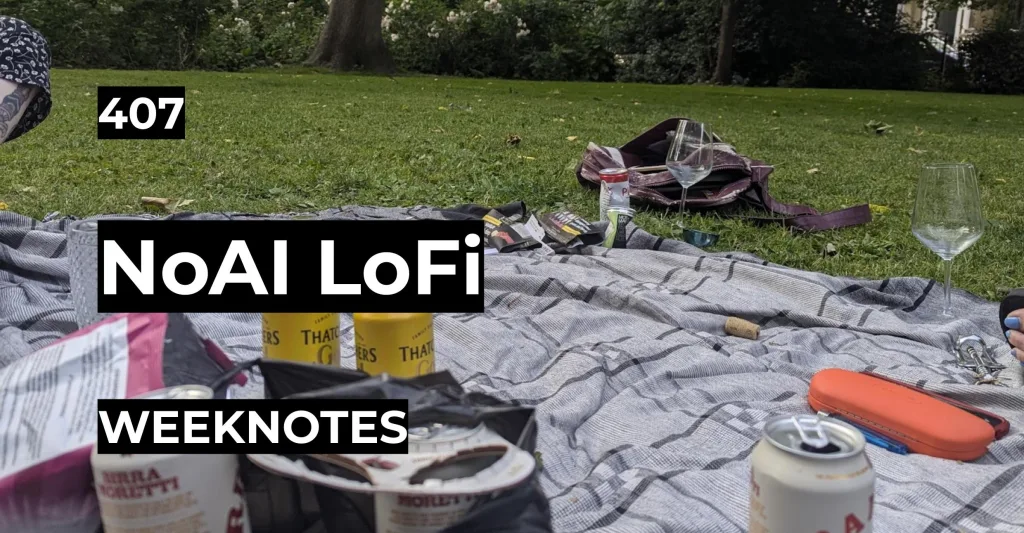

I was really,
under the weather
all week.
Sucked.
NoAI LoFi
A couple of days ago the writer and my friend Andrew Dana Hudson sent me a YouTube link with the following note: “I’m obsessed with these youtubers who make “no AI lofi” but in doing so perform, with their live action bodies, the cozy archetypes of lofi beats station anime characters”
The video itself: an hour-long shot of a man and a woman on a picnic blanket in a tranquil outdoor setting. They are positioned by the edge of a still lake, its surface reflecting the surrounding trees and the pale summer sky, with a pavilion and reed beds visible in the distance. The couple sit barefoot on a patterned orange-and-blue cloth, its surface arranged with a tray of fruit, a teapot and cups, and a small MIDI controller, a scene that is at once domestic and performative. The man plays an orange hollow-body guitar, occasionally leaning over the MIDI controller that is making what can only be described as below-effort beats, whilst jamming over the top on his guitar with consonant melodic flourishes. The woman, dressed in a light sleeveless top and white skirt, her arms patterned with tattoos, alternates between reading a book, pouring tea, and sometimes standing to stretch or play with the golden retriever that lies at ease on the blanket, tongue lolling happily in the warm air.
Nothing about the scene is rushed; it has the quality of an idyll, a carefully arranged vignette of pastoral modern life, where leisure, music-making, and companionship coalesce into something approaching a lifestyle advert. The framing is deliberate, the camera static, and the effect, while meditative, leans towards studied; the slow passage of time is not marked by much change at all, save for the looped beats, idle gestures, and the lazy shimmer of light across the water and leaves.
Like Andrew, I’m obsessed now too, because it’s really wierd example of where culture is at in the midst of the first Information Age Iconoclasm. It’s eating it’s own tail.
Everything about it is just so absurd, a culturally recursive symptom of our moment, a kind of high-concept emptiness that demands investigation.
The question I’ve been trying to answer is: why are they doing this? What the hell is going on?
Loop Culture
The answer of course spirals out of the Lofi Girl phenomenon. But before we can talk about her, I want to return us to the jurassic period of the internet, to a time when websites were destinations.
The first musical loop site I remember is Leekspin (or Loituma Girl) an anime girl spinning a leek, accompanied by a chopped up sections of the scat singing Finnish folk song “Ievan polkka”.
In the flat I lived in after university, we’d just leave it on in the background while playing videogames. The repetitive audio dissolved into habituated ambience; like the sensory adaption to the ticking of a clock in a room. Someone would eventually come home hours later and ask what the hell was going on and why were we listening to it.
Leekspin of course isn’t the only example of this, but it was the first I remember. The hamster dance in the late 90’s became an enormous cultural phenomenon. YTMND another, and of course HEYYEYAAEYAAAEYAEYAA he-man video
All share the same early internet grammar, born from looped GIFS. They are relatives to the Dancing Baby and the Dancing Banana GIF form the 90’s that became paired with ‘Peanut Butter Jelly Time’. My first year at university is punctuated by the emergence of the Badger Badger Badger Mushroom Mushroom flash animation.
Thought the late 00’s and early 10’s the internets loop culture continued to evolve. Looped media reminiscent of the loop sites became durational works. HEYYEYAAEYAAAEYAEYAA for 10 hours, or this visual loop of Gandalf nodding to the Sax Guy solo from Eurovision for 10 Hours, or keyboard cat.
Of course shorter containers were also available, and this mode of expression, the loop paired with music had become the default mode for music visualisers by the mid 2010’s
The most famous to my mind being Nyan Cat. Nyanners who I’ve written extensively about before, posted a similar visualiser for her 2014 cover of NIki Minaja’s I am UR Leader. Both are embedded below to demonstrate the form.
The looped Gif aesthetic is in these videos could best described as placeholders of motion, and netlabel micro-genres like chillhop and vaporwave ran with it.
I do for a moment want to mention Hyperpop. In 2014 Cultural terraformers PC MUSIC post the video for Bobby which apes the looped visualiser Gif aesthetic of the era, but it’s GFOTY as the looped subject.
For a bunch of reasons I don’t have time to get into right now, I think this song and video represents a really important moment in modern cultural canon.
Youtube first introduced live-streaming in 2011, but it wasn’t until the middle of the decade that netlabel produced 24/7 streams really took of, which because of YouTube video first posture, also adopted the looped gif aesthetic for their video element.
It was out of this visual culture that lo-fi girl emerged
Lofi Girl
Literally this week, as I was sitting down to write this 404 Media published a fantastic long read on the history and rise of the Lofi Empire which I’m really glad about so I can just link to that.
Key points of the article useful for understanding this NoAI LoFi are the following quotes:
The livestream, which is one of the longest running live broadcasts on YouTube, is often hiding in browser tabs, leaving the perpetually busy Jade (the Lofi Girl) to lazily take her notes behind whatever Wikipedia page or spreadsheet you’ve got open. But she is always there, the googly eyes stuck to her headphones wobbling as she looks up from her notes, to peek in on, to study with, or to chill to—the details of the music become secondary to the vibe.
ts music has largely dropped the hip hop. Lofi Girl’s music is now simply its own genre: lofi, where the soft, tonal consistency means it can be hard for the average listener to even see its works as distinct songs. The drum beats of the “chill beats to relax/study to” sometimes even take a backseat to the rounded, flighty melodies Dr. Jenessa Williams, a music and fan culture researcher at Stanford University, called Lofi Girl a “deeply valued background noise community.”
The New York Times, in 2018, declared that 24/7 channels like ChilledCow and Chillhop Music were “unlikely to have a broad impact on the music industry,” representing “an underground alternative to the streaming hegemony of Spotify and Apple Music.” They were wrong. Lofi Girl’s core audience might not be able to name a single artist broadcast during a livestream (even if it is driving listeners to Spotify and paying dividends for artists). They may not have even known Lofi Girl has a name. But Lofi Girl is hardly underground
In my opinion, the goal and place for Lofi music in the current moment is to be the auditory equivalent of a beige wall. Over time Lofi Girl sanitised itself into a “homogeneous sound” so palatable to the ear that is become audio wallpaper for the chronically online generation.
As one of its own collaborators aptly put it, this isn’t about artists expressing themselves anymore; it’s a record label curating a “functional” experience. The creative brief of lo-fi girl in 2025 is to produce something so predictable and “search engine-optimised” that its greatest selling point is that you hardly notice its presence.
This is important as it’s one of the things I think is insane about the NoAI LoFi couple.
Stylised stillness
The defining visual gesture of LoFi Girl is what in theatre we would call a kind of ‘stylised stillness’. She studies forever, a perfect, looping machine of productivity.
These “no AI” performers have taken this as a creative challenge: to become the animation. The human presence is insisted upon yet their performance is entirely within machinic-constraints, a stylised stillness as empty content, lacking narrative, or any progression. They are capturing a moment, a vibe.
Looped media has of course always meant to be lived with, not watched. Think of William Basinski’s Disintegration Loops, durational works defined by consistency and mood. Time suspended; attention cushioned rather than captured. LoFi Girl industrialised that and created a perpetual ambience machine.
The music itself is empty too. The same creative brief as LoFi Girl, calling it ‘low-effort’ is generous of me. Improvised guitar lines with predicable progressions that don’t go anywhere over chill hop beats. This genre’s popularity is another example of the smooth flatness of all media in our era that I’ve written about before. It’s lowest common denominator online ambience. Music made not for your ears, but for the cold, dead heart of the algorithm.
Let me be clear: I couldn’t sit on a picnic blanket in a park for an hour and noodle on a guitar without fucking up. But nor would I like to try, I would actually rather have AI generate it for me.
I genuinely find the spectacle on display in this video quite breathtaking: humans, desperate to prove they aren’t AI, performing as looping, predictable machines to create SEO-friendly wallpaper audio. Content and commentary fusing to absurdity. Presence over plot.
Of course this format thrives on YouTube. There are pragmatic reasons.
- Watch-time incentives: they are long in duration with low narrative overhead.
- Video compression: tiny gestures read well on small phone screens even if out the corner of your eye.
- The lamps and contents of LoFi girl’s room, the couples blankets, LoFi girls rainy window all contributes to instant vibe recognition.
Agency Fetish
In their ‘super lecture’ Non-Player Dynamics: Agency Fetish in Game-World, Marek Poliks and Roberto Alonso Trillo of Disintegrator podcast talk about how “the commentariat is flushed with images of humans spending their time play acting as AI… this trend has gotten kind of weirder and more literal”
They use the example of Pinkydoll and the other NPC TikTok streamers. Performing canned phrases with repeated gestures mapped to gifts. They are in themselves real-time human loops; bodies as event-driven interfaces, like the human statue street performers of Covent Garden reimagined for the digital age.
When someone sits live on YouTube and performs the “study girl” loop, or when Pinkydoll repeats NPC gestures on TikTok, these people are adopting ‘machinic patterns of presence’; they become non-player characters in their own streams. The performance of the loop is a ritual of surrendering agency to platform dynamics, while simultaneously trying to reclaim it through human embodiment.
Their lecture argues that under “exocapitalism”, labour is less about production and more about representation work: stylised gestures, narratives, or symbolic performances that slot into algorithmic loops, and live-action gif loops are exactly that—representation of “studying” or “relaxing” as an endless gesture, consumed as ambience.
The performer isn’t producing knowledge or beats; they’re embodying a ‘node of affect’ in a network of platform aesthetics. They turn themselves into an interface.
In The YouTube Apparatus (2024), Kevin Munger describes YouTube as a dynamic feedback system in which creators, audiences, and infrastructure shape each other in real time. The whole thing is a a Supply and Demand Framework: creators produce, the platform quantifies audience response (views, likes, comments, watch time etc), and these metrics rationalise future production.
My poetic aspiration is that whenever you read the words “YouTube Creator” you think instead of “Audience Creation.” Social media does not create powerful Influencers but rather powerless marionettes, dancing jerkily to quantified audience tugs.
One of the important points Marek and Roberto share with Munger about the algorithmic environment is that whilst platforms deliver the feeling of agency; the actual capacity for action within them narrows. Performance on them becomes constrained by pre-given moves; dictated by platform, by human, and by algorithm. This couple’s “no AI” tag signals agency reclaimed, but in practice they are ceding their creative agency entirely to the platform and the algorithm.
They have become the human equivalent of that cosy fireplace video on Netflix.
Human Wallpaper
I’m sure the NoAI Lofi couple are lovely human beings, but I’ve just written a lot of words to justify why I don’t like something. Which is ironic considering the theme of last week’s weeknotes. But you can just not like stuff too I guess. Their loud signalling that there’s no AI is all very well, but then going on to produce work/art thats completely empty of meaning is to my mind insidious. Foregrounding your own humanity only to turn yourself into human wallpaper is baffling.
But I remind myself that most ‘creators’ on the internet are not creating things for viewers, or for me personally. The algorithm is always the primary consumer. Everyone else is incidental, including the audience. It might as well have been entirely produced by AI to begin with. Thats what people are hearing when they listen to this low effort gunk on Spotify anyway.
These live action videos are the non-player dynamic made flesh, and reveal how far the “agency fetish” has gone: we can celebrate creative self-performance, but what’s really happening is recursive modelling, the human becoming infrastructure.
The whole thing is a sort of Turing test in reverse. The artists are involved in a competition to see if they can be as flawlessly bland and algorithmically pleasing as possible to the machine.
In anyways this sort of thing is the apotheosis of ‘content’ laborious and artisanal production of work so seamless, so devoid of friction, that the only remaining purpose of it all that I can possibly see is to generate enough training data to then go on to automate the whole thing.
On The Blog
I’ve basically been sick all week. But I have been posting over on BYENNE
If the shape isn’t stewarded,
it collapses.
And the stories leak out.
You won’t even notice
until it’s too late.
Start Select Reset 📑
Subscribing to SSRZ supports my online work and creative projects.
As a thank you, I send you my zine four times a year, just like it’s 1994.
Photo 365
The Ministry Of My Own Labour
- 2 Calls.
- Working on the game launch.
Mostly been sick.
Terminal Access
Tracy Durnell wrote a fantastic piece this week called ‘Online feels truer than material reality’ its really worth your time. A bricolage of sources and thoughts from across the blogosphere:
Because most people online are funneled into a handful of websites, the signaling environment is competitive. “Status” isn’t like a leaderboard with direct rankings, but we can be high or low status within our taste world. Social media rewards our desire for status with attention and validation for treating every pursuit as an opportunity to signal.
Dipping the Stacks
It would be great to see the xAI version of Meta’s 200 page document. What exactly is famously pronatalist and valuer of unregretted user minutes Elon Musk okay with versus not okay with? At what age should bots be okay to say what to a child? Exactly how toxic and possessive and manipulative should your companions be, including on purpose, as you turn the dial while looking back at the audience?
Welcome to the Era of Astroturf Fandom
Once again, the digital era’s ballyhooed capacity for citizen participation and “the long tail” has been crushed in favor of top-down control by giant corporations. The promise of the internet was that the gatekeepers would be dethroned, that cultural movements would erupt from the crowd. Instead, we’re living in a Potemkin village of virality where the audience is always the mark and the trick is always the same.
The sovereign individual and the paradox of the digital age | Aeon Essays
Data has created a new and paradoxical social order: the promise of emancipation is made possible by classifying everything
The new solar: what colour panel would you like?
It’s a demonstration that serious solar installations can defy aesthetic expectations. No need to bolt clunky rectangles all over your roof. Solar companies are coming up with snazzy alternatives that can form part of the roof structure itself – or provide an ultra-modern, colourful façade.
Britain’s statistics scandal means it cannot answer its most pressing questions
Autocrats and authoritarians routinely distort or even disappear economic data. In a statistical twist on Hanlon’s razor, Britain is achieving a similar result not out of malice but incompetence.
Reading
Not had that much time this week. Still reading The Heart Aroused: Poetry and the Preservation of the Soul in Corporate America by David Whyte. And still reading The Universal Christ: How a Forgotten Reality Can Change Everything We See, Hope For and Believe by Richard Rohr
I picked up An African History of Africa: From the Dawn of Humanity to Independence by Zeinab Badawi on Audible but I’ve only just started it. Badawi is fantastic at performing her own words.
Music
Condemned to Torture – Must Kill
UK thrash metal band Must Kill have a new album out. It fucking rips.
Lead single Nightmares come to life is my favourite track:
Remember Kids:
Strangely, this sense of spinning never completes itself in the way you would feel if you stood and turned your body in a complete circle. At least in my own experience, it feels as if the spin is constantly beginning—but never completing—its rotation. We can learn from this that vertigo interferes with a vital function of the vestibular apparatus, which is to help you orient your body in space.
How You Stand, How You Move, How You Live by Missy Vineyard