
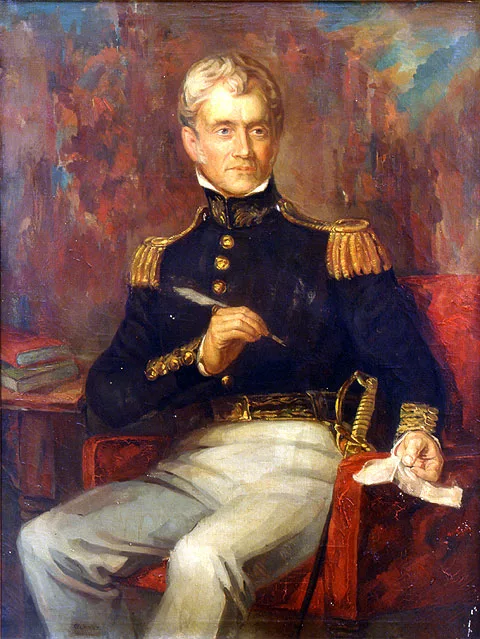
Where did modern bureaucracy come from? Colonel Sylvanus Thayer, the Father of the Military Academy, or the ‘man who made West Point’.
Full Show Notes: https://thejaymo.net/2024/07/07/2414-the-origins-of-modern-bureaucracy/
Support the show!
Subscribe to my zine
Watch on YoutubePermanently moved is a personal podcast 301 seconds in length, written and recorded by @thejaymo
301 // Permanently Moved
Show Supporter 📻
Support the Show
Quarterly zine; my gift to you.
The Origins of Modern Bureaucracy
I’ve been researching the history and development of techno-social systems for my world’s book. What are the origins of modern bureaucracy? How did corporations become singular information worlds, anchored by central databases?
I’m interested in the emergence of what James C Scott calls ‘Authoritarian High Modernism’. Whilst his book Seeing Like a State outlines the historical development of the concept of legibility and record-keeping in the late 1700’s and early 1800’s, it doesn’t offer any detailed specifics of who, what, and where.
So today, I’m going to tell you about Colonel Sylvanus Thayer. Known as the Father of the Military Academy, or the ‘man who made West Point’.
Materials for today’s episode are drawn from James William Kershner’s 1976 doctoral thesis, Hoskin & Macve’s 2000 paper “Knowing More as Knowing Less? Alternative Histories of Cost and Management Accounting”, and Neil Postman’s 1992 book “Technopoly.”
Sylvanus Thayer
Sylvanus Thayer was born in 1785 and attended Dartmouth College. Graduating in 1807, he was then personally appointed to the West Point Military Academy by President Jefferson. He graduated within one year and was commissioned second lieutenant in the US Army Corps of Engineers in 1808 at the age of 23.
Active during the War of 1812, Thayer directed the fortification and defence of the city of Norfolk, Virginia. Then after the war, he travelled to Europe in 1815.
His mission: To study the latest developments in science and engineering.

In Paris, Thayer spent two years studying at École Polytechnique – a crucial moment in this story – as the university at the time graded student examinations by giving out numerical marks. Receiving school grades on term papers, or a score at the end of a performance review at work seems obvious to us now, natural even.
But back in 1815 when Thayer was in Paris, the idea was still new.
The concept of grading student papers was proposed by Cambridge University tutor William Farish and first implemented in 1792. The practice then quickly spread across European universities. As Neil Postman notes the “idea that a quantitative value should be assigned to human thoughts was a major step toward constructing a mathematical concept of reality”.
A world model as it were.
In 1817, President James Monroe ordered Thayer back from Europe to become the superintendent of West Point Military Academy. Upon his arrival, Thayer found total chaos: students skipping classes, many in debt from selling their pay books, and rampant insubordination and drunkenness.
He set to work immediately. His reforms included setting new standards for admission, and minimum levels of proficiency, and implementing a system to measure cadets progress.
A military academy is a total institution and is therefore, a world of its own.
Within any techno-social system there are two approaches towards responsibility for and of participants within the system. The first is that the system itself is responsible for its participants. Like in a prison or a hospital.
The system has responsiblity for the care of and control over all the actions of the world’s inhabitants. A weaker form of this is when individuals are accountable for their actions, but the system itself is responsible for them – like in a corporation.
The second approach is that responsibility for actions taken within the world fall on the participant alone. Like in most video games – or in the example I’m about to give – Education. One of Thayer’s innovations at West Point was his philosophy that cadets are responsible for their own learning – not the institution. This approach, now known as the Thayer Method, emphasises the role of the individual in their education.
“We provide the environment, you do the learning”.
The Grammatocentric Principle
Thayer’s West Point environment was divided into two divisions. Each organised hierarchically in a line-and-staff system, much like a modern business. In addition to the introduction of grades, professors and section leaders were required to file written reports every Sunday on the progress of their students. A system was then instituted in the central office to keep track of which cadets had neglected their lessons, or not made suitable progress.
As Hoskin & Macve write: “Daily, weekly and monthly reports were required, all in writing. There were continual relays of written communication and command, going from the bottom to the top of each line, before being consolidated and passed to the central ‘Staff Office.’”
He also established an internal economy with budgets for departments and individuals, controlled through a hierarchical system of double-entry, charge-discharge bookkeeping. This marks the beginning of what Hoskin & Macve call modernity’s ‘grammatocentric principle’. Meaning, when everything began to be organised around the use of writing, and the flow of information.
This approach of course significantly influenced West Point’s graduates. Who took this new style of management into industry. In 1800s America, Thayers graduates were instrumental in creating the modern age. Like working on the railroads – the first American businesses to operate with a formal administrative structure manned by full-time salaried managers. In the oil industry, and interestingly at Springfield Armory. The place that developed single process manufacturing, 50 years before it became known as Fordism.
So despite the military environment, Thayer preferred to rule indirectly through information. Reports, charts, memos, and personnel files – much like a modern CEO.