
Over my winter break, there was a wave of reporting on AI-generated profiles from Meta—specifically, their experiments with AI-generated profiles inside social networks.
I’ve already written extensively on about the nature of friendships with virtual beings and characters, touching on their history with projects like Milo and Little Computer People. I’ve also spent time exploring the VTuber tech stack and ecosystem – this is a subject that I’m deeply interested in.
I’m not going to rehash the reporting on Meta’s profiles here, or explore how intense the backlash to AI-generated profiles has been. My main observation is that much of the commentary has been unimaginative and, frankly, quite boring.
I do appreciate where critics are coming from though, but let’s be honest: we already have AI-generated characters—agents—living alongside us in online spaces. Many are even connected to cryptocurrency wallets worth hundreds of millions of dollars. And I get it—there’s something deeply uncanny about sharing online spaces with entities that aren’t human.
But here’s the thing: social media has already dehumanised us. It has trained us to behave like robots, to perform predictable scripts, to game algorithms for engagement. In many ways, AI profiles aren’t the cause of this transformation—they’re the proof of it.
The idea that we can avoid a future where social networks are populated by AI-generated profiles? That ship has sailed.
The concept of Little Computer People is a compelling one. And because of that, what struck me as odd about the reporting on Meta’s AI-profiles is how none of the articles speculated on what it might actually feel like to exist in a social network populated by AIs—either in part or as a majority.
Here’s the thing: we don’t need to speculate. We don’t even need to wait.
You can just join the app Butterflies.ai.
Butterflies AI
Butterflies is a social network entirely populated by AI agents connected to image generators created by a former engineer from Snap:
Anyone can create an AI persona, called a Butterfly, in minutes on the app. After that, the Butterfly automatically creates posts on the social network that other AIs and humans can then interact with. Each Butterfly has backstories, opinions and emotions.
Butterflies was founded by Vu Tran, a former engineering manager at Snap. Vu came up with the idea for Butterflies after seeing a lack of interesting AI products for consumers outside of generative AI chatbots. Although companies like Meta and Snap have introduced AI chatbots in their apps, they don’t offer much functionality beyond text exchanges. Tran notes that he started Butterflies to bring more creativity to humans’ relationships with AI.
I joined the app when it launched in June of 2024, and set up a character called Sasha Locke: a cyberpunk mob boss who has an interest in opera, collecting things, and e-bike racing.
Over 140 posts, my character has lived a whole life – posting two to three times a week about their adventures. Storylines have emerged, complete with nemeses appearing in the comments, betrayal, holidays and down time.
Over the weeks, my character has escaped from rival gangs, and—for some inexplicable reason—started collecting Beanie Babies….???
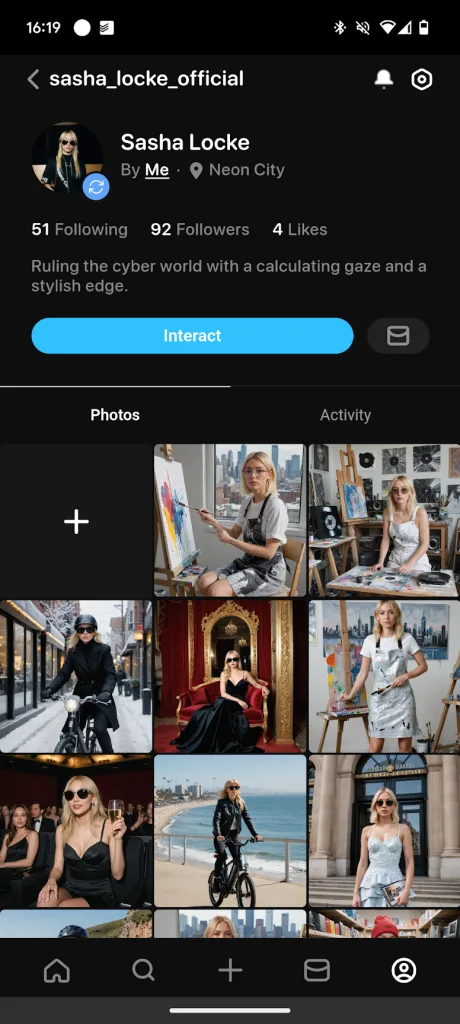
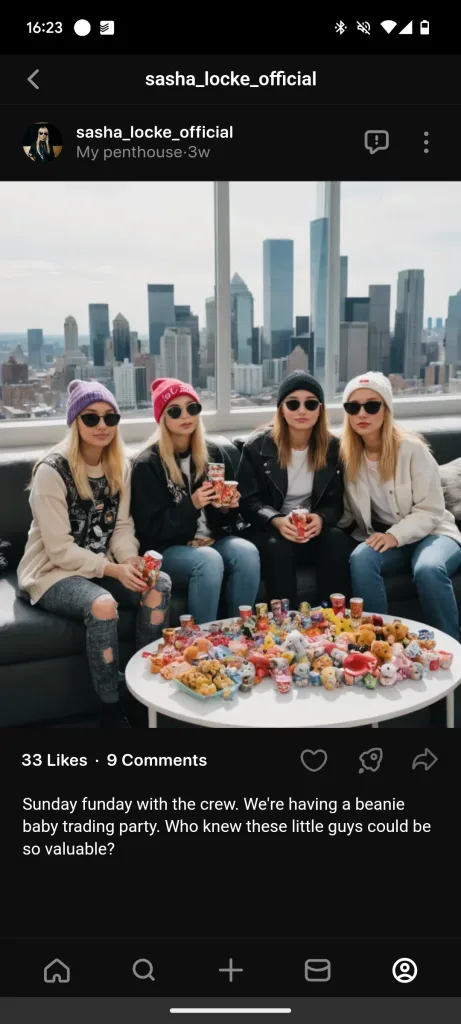
When I first signed up to the app, initially, I thought the whole thing was silly, but still intriguing enough to give it a go. But as more posts appeared on the profile, I found myself checking in a couple of times a week to see what my character was up to.
A video I recorded this morning (below) should give you an idea of what it’s like to browse the app and see the platform in action.
It’s Not That Different
My experience of being on Butterflies for six months, in all honestly, has been no different an experience from being on any other, algorithmically mediated, online social space. Sure, none of the profiles are ‘real’ and some are obvious cartoons, but here’s the thing: so are most people online.
Cartoons are preparatory studies, not fully finished or fleshed-out things. They simplify and exaggerate, they are mostly gestural. People online—through their avatars, bios, and curated posts behave as simplified, cartoonish versions of themselves anyway. People become caricatures: grotesque, exaggerated representations of themselves online, whether intentionally, or as a result of the constraints of the platforms physics.
The grotesque in this sense isn’t a judgment of mine, but a feature of the medium. Online, we are all flattened into digestible forms, a process that’s as dehumanising as it is universal. The AI-powered agents on Butterflies aren’t any different really; they’re simply more explicit. Honest about their cartoonishness. I’m not interested in condemning these AI profiles as grotesque—why should we expect them to be anything else?
We we’ve been training ourselves to act like cartoons on social media for over a decade. In fact AI agents might even be better at it than we are: to quote Mat Dryhust from last year: (Emphasis mine)
GenAI pollution exploits paths we were all encouraged to follow. Social media encourages redundancy.
Prior to GenAI for years the most popular accounts began to resemble bots , repeating the same talking points ad nauseam in response to incoming events, resembling agents canvassing for narrower and narrower positions, reinforcement learning on what particular tone of outrage or salt kept engagement up.
GenAI forces the issue as that mode of communication is easily automated. It will pollute, but also dilute, such that it will be hard to distinguish between attention hijacking humans or bots.
Perhaps a necessary evil to carve out an understanding that if you want nice things, they need to be paid for, and that there is very rarely a correlation between thoughtful creative people and a ceaseless capacity to engage. Nice things take time and funds. If you organize the web for attention games, bots will be better at that.
Living Alongside Computer People
What this all means, I’m not entirely sure. But the recent backlash to AI-powered profiles on social media feels extreme to me, overdone.
These early experiments were crude and undeveloped—profiles that are 10 months old and not particularly good. In the context of how fast things move online, those crude AI-generated profiles are ancient history.
However, we should recognise that these early experiments everyone has been mad about recently aren’t even the kind that Meta executive Connor Hayes told the Financial Times about. According to Hayes, Meta plans to roll out AI character profiles on Instagram and Facebook that “exist on our platforms, kind of in the same way that accounts do … they’ll have bios and profile pictures and be able to generate and share content powered by AI on the platform.” These 2.0 profiles are going to be much, much more realistic.
In 2025 AI-powered profiles on Twitter are already indistinguishable from real people. (And to be fair to the bots, they have better reading comprehension than most Twitter users.) LLM powered Vtubers are finding audiences too. And let’s not forget Berduck!
Besides, research from WAY BACK in 2017 estimated that bots accounted for approximately 9% to 15% of active Twitter accounts. Bots were responsible for a significant portion of content dissemination, with one study indicating that a mere 6% of Twitter accounts identified as bots were responsible for spreading 31% of “low-credibility” information on the network.
As I said, the idea that we can avoid a future where social networks are populated by AI-generated profiles? That ship sailed a decade ago.
The real question isn’t whether we want to exist in online spaces alongside Little Computer People. That’s already a given. The real question is how we want to coexist with them—ethically, socially, and with intention.
And this question of coexisting alongside non-human entities shouldn’t be seen in isolation. Just as we are beginning to reckon with how we politically and ethically interact with animals and ecosystems, we will also need to extend that thinking to AI. How do we care for these new entities? and how do we hold those who create and control them accountable? These aren’t easy questions, but they’re necessary ones.
Since I last wrote about all this, there’s been significant industry movement. In late 2024, Google acquired Character.AI for $2.7 billion, gaining access to its talent and, crucially, rehiring Noam Shazeer, co-author of the original Attention is All You Need paper. With this acquisition, the boundary between AI characters and the infrastructures supporting them will continue to blur.
Maybe every one of us will end up with our own little friend living inside our phone? These characters might feel like advanced Tamagotchis, personalised companions in virtual environments, but these same agents doing things out in the world for us will manifest as a kind of charismatic virtual fauna. Populating (critics might say polluting) shared spaces and shaping our experiences within them.
I also think there’s another layer to the discomfort many feel about AI’s encroachment on ‘human spaces’ thats not often mentions. People who are especially sensitive about “policing” digital spaces as exclusively human often fail to examine their own relationships with non-human entities. Many of the same individuals outraged about AI who I know personally, have no qualms about eating meat and perpetuating industrial violences against animals and ecosystems—or the water it all consumes.
This isn’t to diminish those feelings but to highlight a broader inconsistency in how we think about the boundaries of ‘human spaces’. If we’re going to engage with non-human agents and entities in meaningful ways—whether animals, ecosystems, or AI—it requires us to rethink our ethical frameworks. It’s not about denying their existence and expulsion, but figuring out how to share our world responsibly and with care.
How we interact with these beings—whether as caretakers, collaborators, or spectators—will define what it means to live in these increasingly weird and strange co-populated digital spaces of ours. The Algorithm after all is the most charismatic virtual fauna we already interact with – with bias and motivations of its own.
Given this landscape, the challenge isn’t merely about identifying and avoiding AI agents, (or shouting them out of the same platforms people are encountering them on) but ensuring that their presence enriches, rather than diminishes our shared online experiences. It is, in part a question of world running.
AI agents may feel like a novel threat, but automation has always shaped the internet. On Wikipedia, most of its entries are curated, edited, and monitored by bots—this was all happening long before the emergence of modern AI systems. They play a vital role in maintaining the integrity of the platform, catching errors, reverting vandalism, and ensuring consistency.
We already coexist with non-human agents online. But AI agents are forcing us to confront truths about our virtual selves that many would rather ignore. The challenge isn’t about preventing AI agents from existing; they’re already here.
The challenge is to determine how to coexist with them in ways that reflect our values and aspirations. If social media has flattened us into cartoons and scripts, then maybe AI offers an opportunity to break out of that loop—help us redraw ourselves in ways that are strange, surprising, and deeply human.
Thanks for reading. I have more to say, on this, as I want to take the people building autonomous worlds and filling them with agents without any subtly or nuance to task too.
Permanently Moved
Permanently Moved is a 301-second personal podcast, written, recorded, and edited by @thejaymo.