
Make a gesture and say the word
And a tiny new world is stirred
Keep the tech off your face,
just a box in your space
and promptable future occurred!
Promptable Hardware
On Thursday evening, I headed into the city for the launch of Inanimate.tech‘s 2026 object collection.
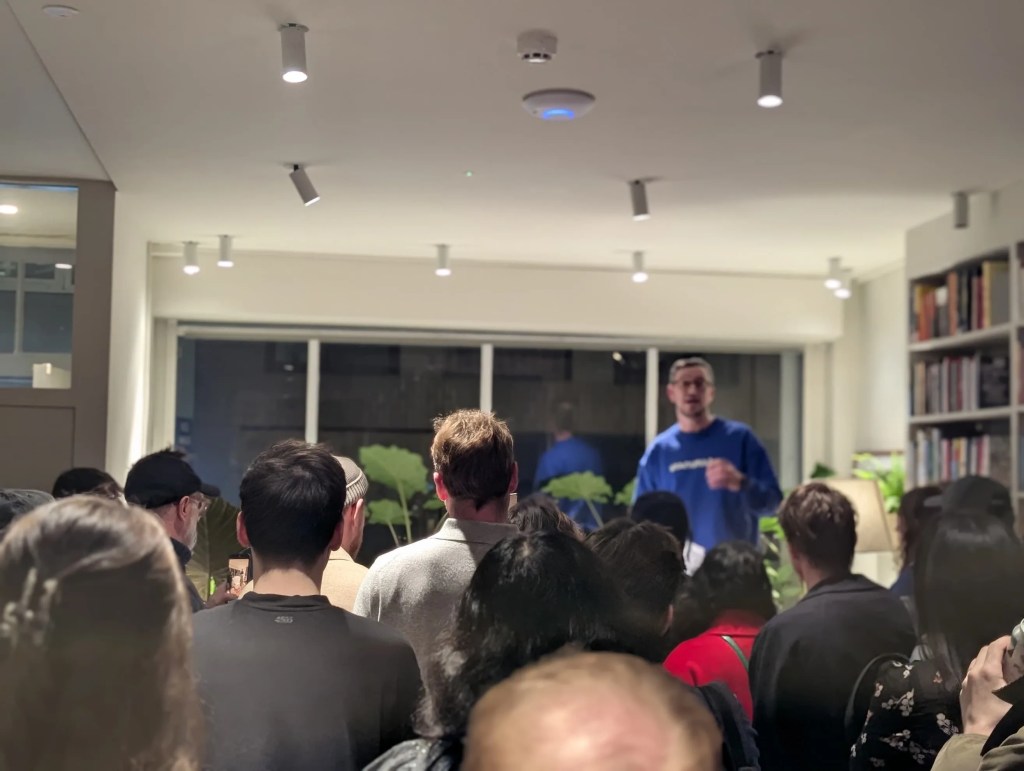
Huge congratulations to Matt Webb and Daniel and the team. That they exist at all is remarkable, and the industrial design sits right in that sweet spot of mature prototype.
Inanimate’s thesis is promptable hardware.
Personal AI devices that know what you want and do what you mean.
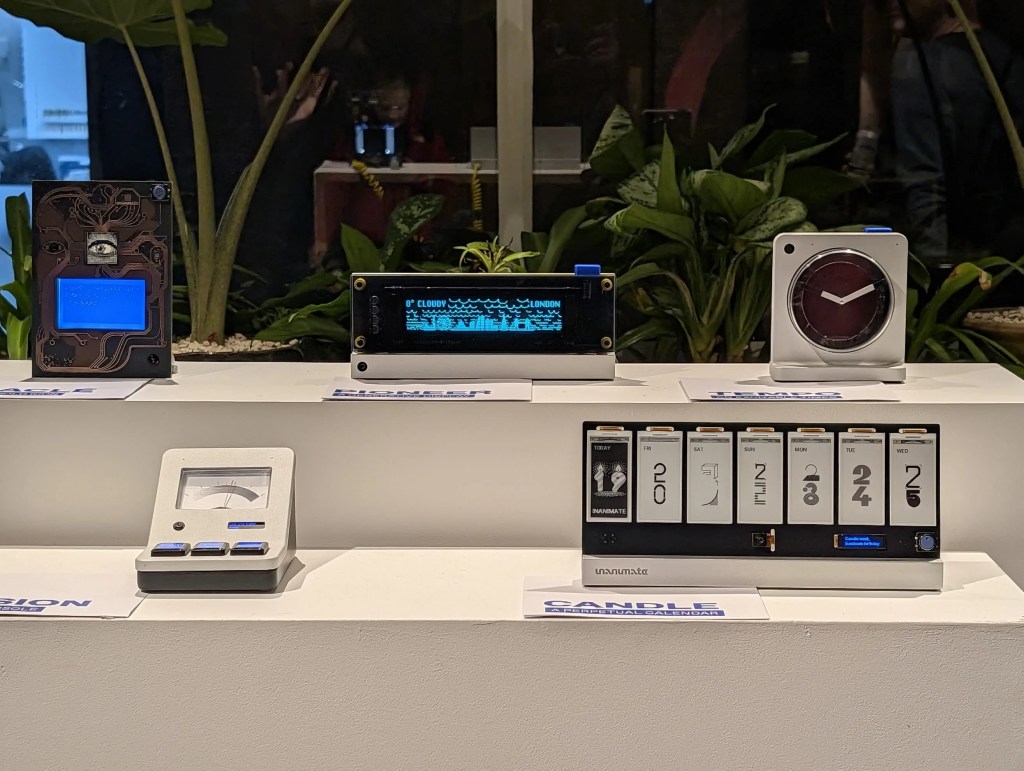
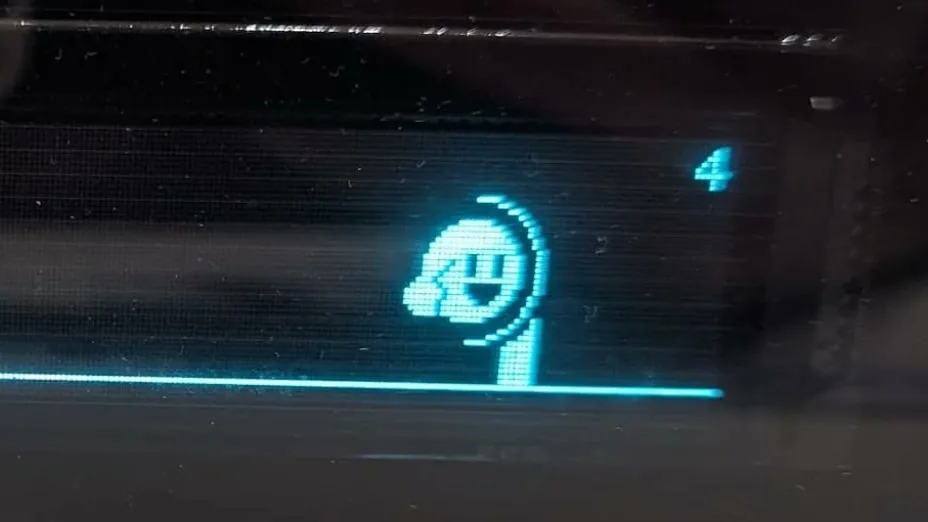
Each object has a microphone, a camera, and a web connection to your AI agent. Inanimate provides zero cloud infrastructure for the devices. To wake it, you turn toward the camera, press a finger to your ear like Lieutenant Uhura in Star Trek: TOS, and speak your request. They have a little guy that displays the same gesture on-screen to show when it’s listening:
Speech-to-text then routes that prompt to your own agent harness, which builds and deploys a new feature or UI straight to the device. You don’t need to flash any firmware, it all runs with hot reloaded Lua atop Inanimate’s generic ESP32 sandbox, Resident.
Spending time in the demo room felt like a glimpse at a future, and there’s something magical about it. I say a future rather than the future because AI hardware is splitting into two camps: body-worn gear (glasses, hats, headphones) which are all the things inviting the privacy backlash and “perv glasses” accusations. Ambient home objects meanwhile, like the ones Inanimate have built, are closer to an Apple HomePod or Google Home device.
Here’s what I prompted while testing them out:
On the 7-screen e-paper Candle, I vibe-coded a daily tarot spread where nodding your head flips the cards one by one.
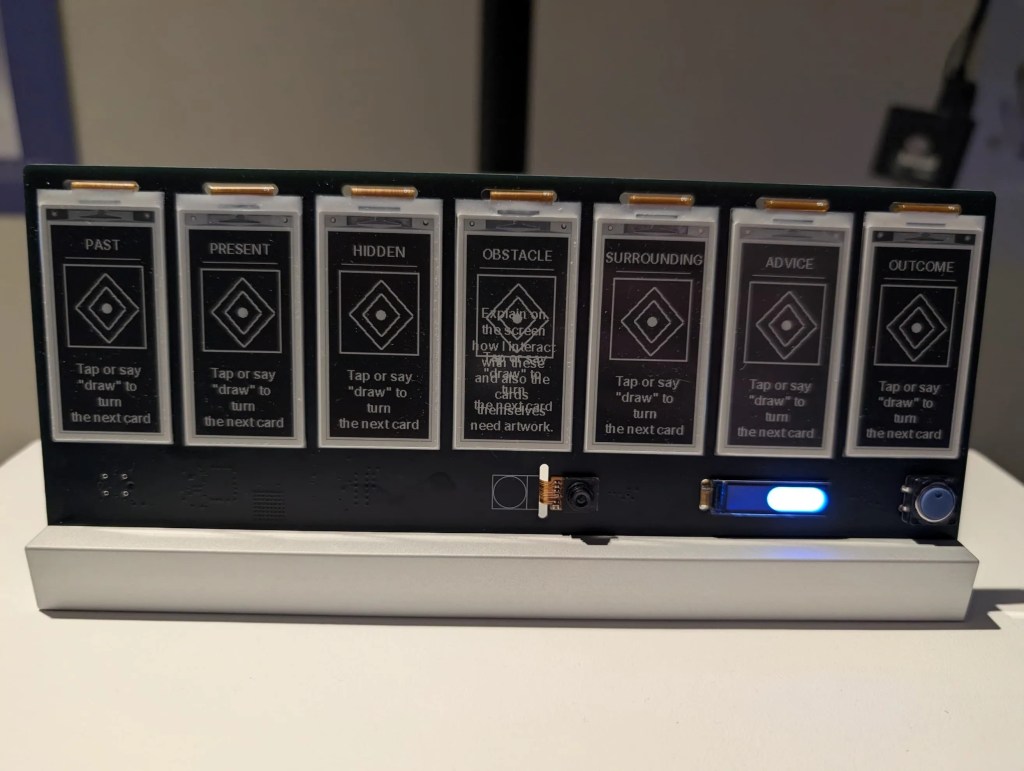
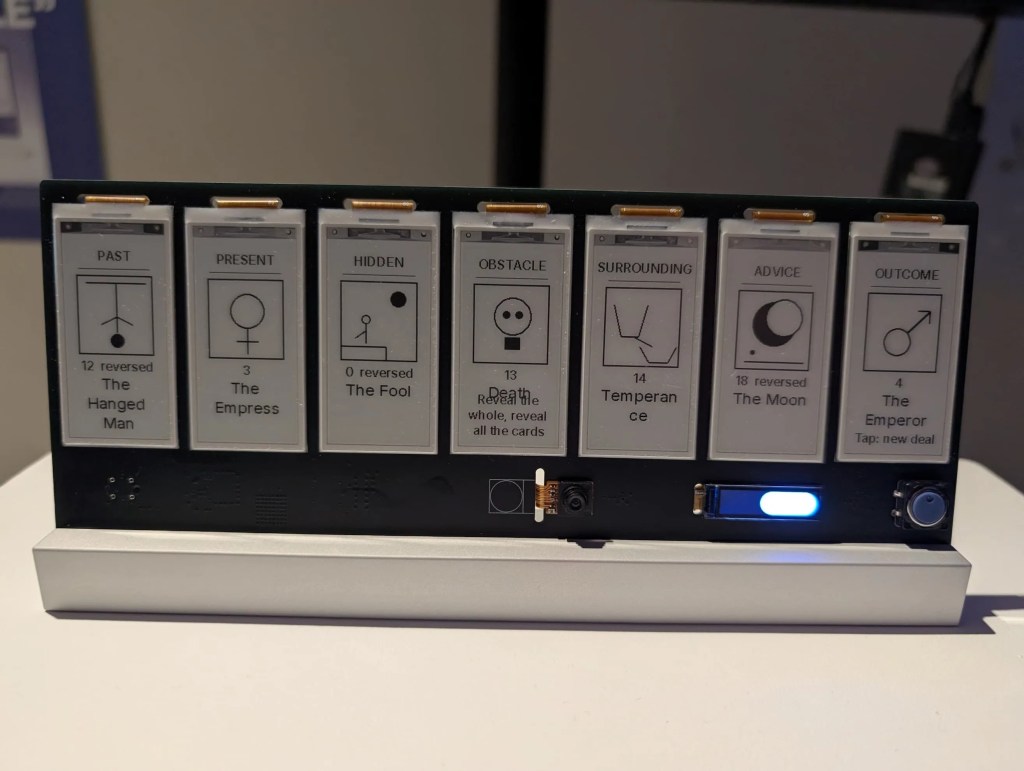
Fun, but I wanted to see what games I could squeeze out of these form factors:
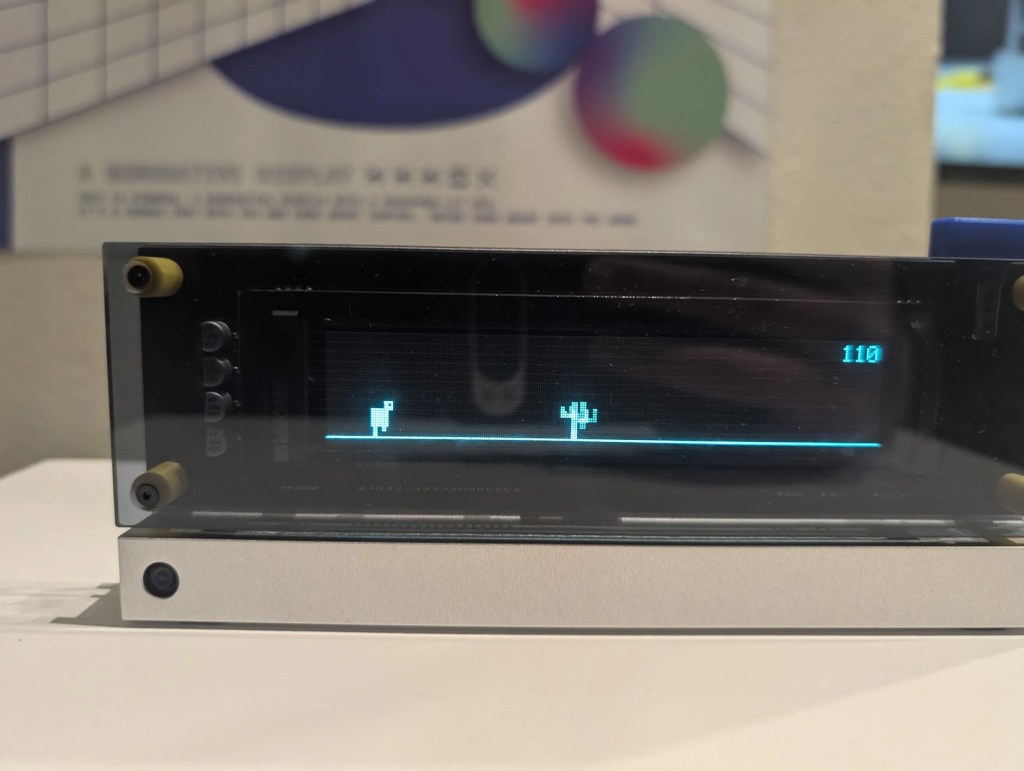
On the car-stereo-style screen, I built a Chrome Dino Runner clone that speeds up as your score climbs. I tried using the camera for jump gestures, though hardware sandboxing meant the only working trigger was an awkward head bob. Which, given the screen’s height on the pedestal, forced me to do squats to play. Still great fun tho.
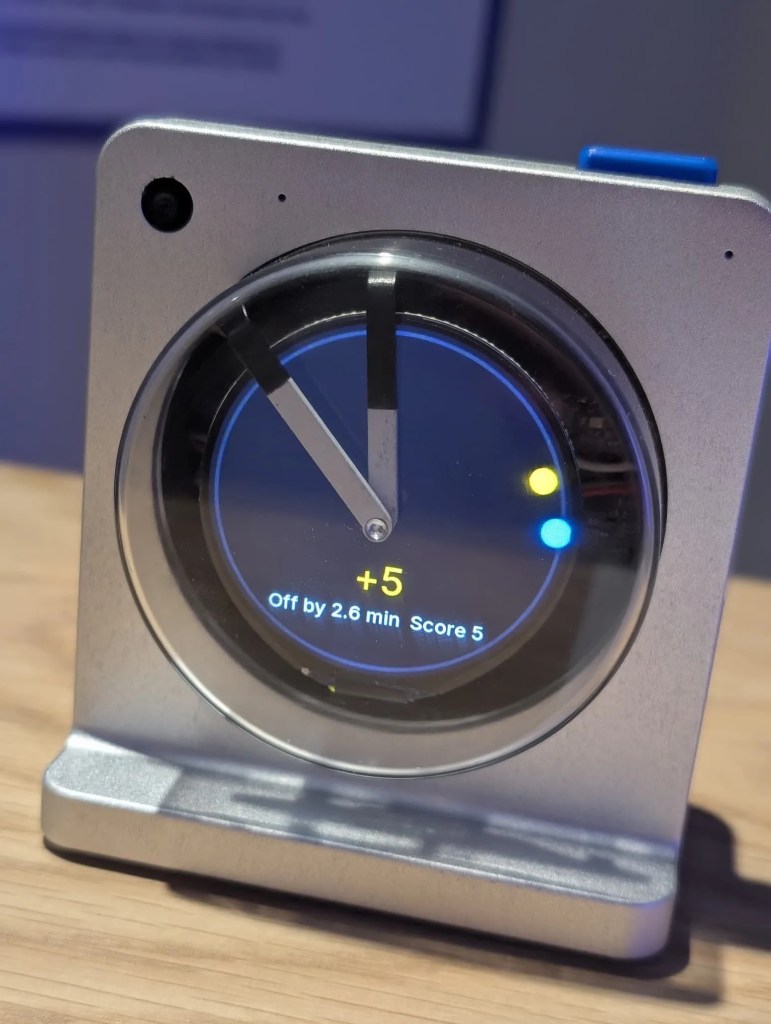
On the clock, I made a reaction-time game: start and stop the minute hand as close to the target markers as possible to score.
I don’t have a photo, but I built another reaction game on the analog meter with ready, start/stop, and reset buttons. Something was off with the calibration—either my vibe-coding or the hardware, though screaming prompts in a noisy room probably didn’t help.
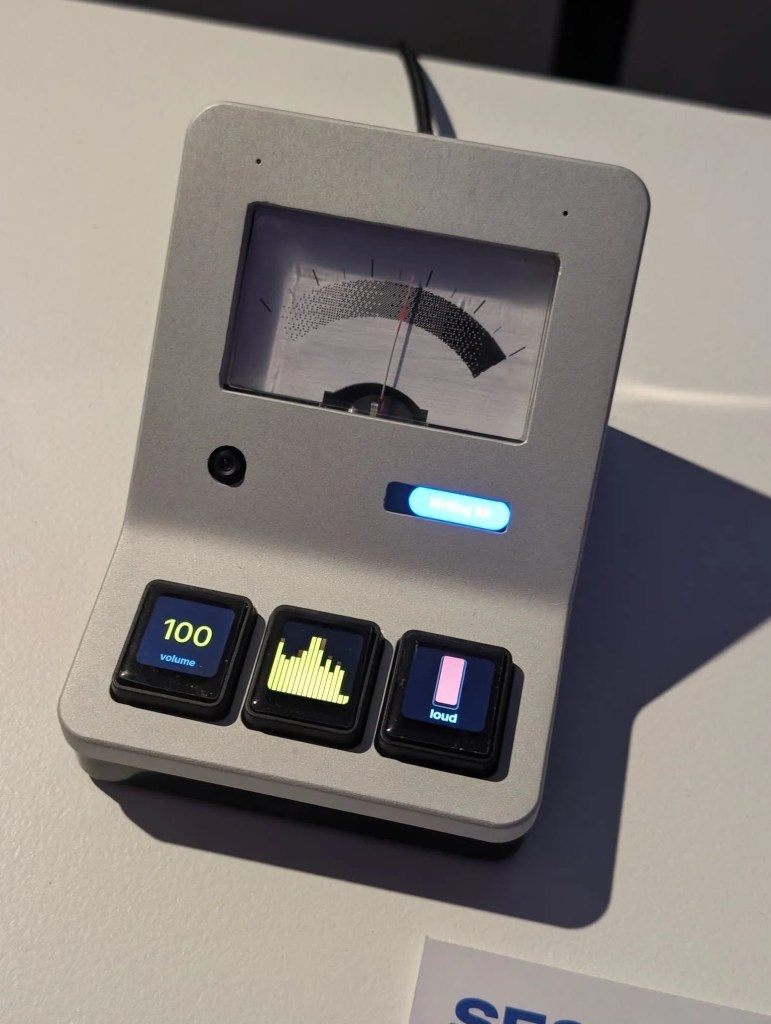
I drew a blank on the Oracle, so I skipped making a game for it.
Finally, I went back to the Candle and built a deterministic, Sims-like simulation: seven little characters living in separate rooms with furniture and pets, each running on their own daily schedule: waking up, working at desks, lounging on the couch, going to bed etc
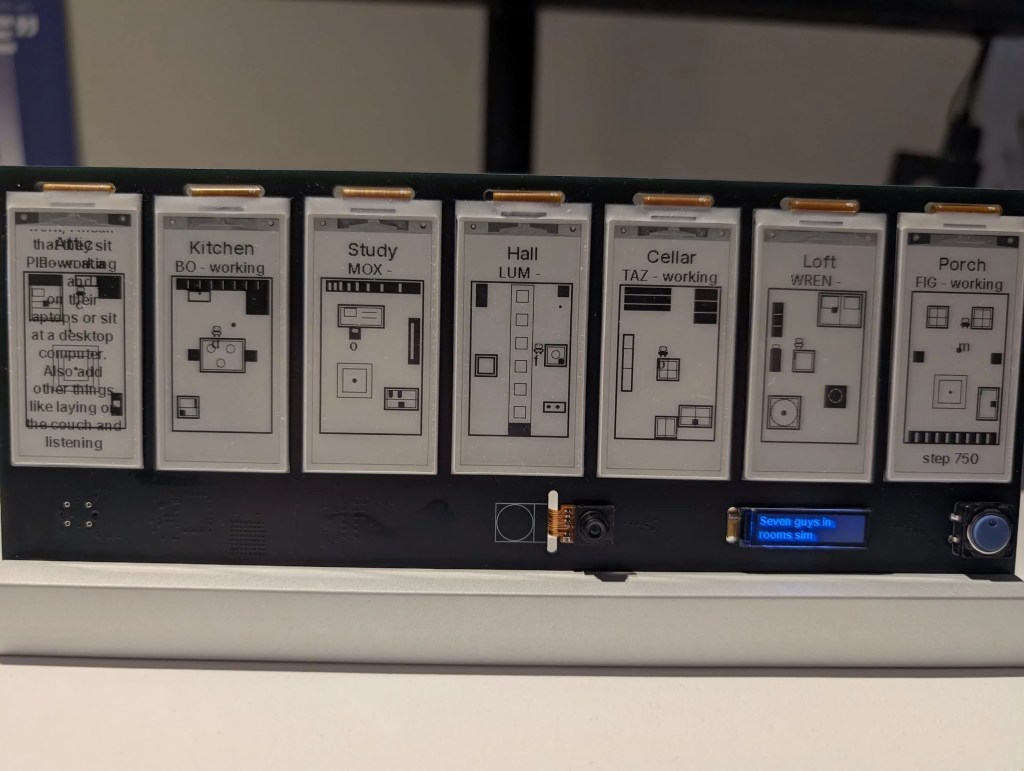
After roughly five rounds of iteration, I had them visiting each other’s apartments to hang out.
Seeing the vision come to life so quickly was the highlight of the night.
I’ve been vibe-coding hardware interfaces myself this year, mostly messing with an ancient, decrepit Kindle, and I’m also in a group chat with folks hacking on ESP32s, so their interaction model didn’t feel completely alien.
I wrote on the blog ages ago about liquid UI and the delamination of front and backend, putting an LLM in the middle to generate “on-the-fly UI.” Seeing hardware built from the ground up around that thesis is thrilling.
A similar wave is happening in synthesizers: hobbyists reverse-engineered gear to write custom OSes, pushing manufacturers to open-source their firmware outright. People are doing the same to strip spyware out of smart TVs. Everything you own, can be owned.
As I argued in that liquid UI post, I reckon in a few years most devices will ship with on-device ASICs running inference locally so hardware can generate its own UI on the fly. How it all shakes out is anyone’s guess, but it’s exciting.
Huge shout-out to Inanimate. Pulling off physical hardware this fast as a UK startup is no small feat, especially in the current climate. I reckon they are effectively neck and neck with OpenAI and Jony Ive’s hardware lab, except they’re building in public, and the world is better for it.
Matt must also be proud. He’s been tilling this soil for 20 years, stretching back to BERG. You can draw a straight line from their early IoT experiments and the Little Printer, through Matt’s Poem/1 clock, right to the devices I played with this week.
Really glad this is happening in London. Thanks for the invite!
On The Blog
MACHINE MEMIOR – Permanently Moved
I got a new episode of Permanently Moved out this week! A long time coming! But very pleased with it.
A life with computers.
Machine Memoir is an audio essay about the computers I was around whilst growing up: where I was, what I was doing with them, and in some ways, what they did to me in return.
Zine will be shipping next weekend. If you ‘d like too, become a regular supporter before Wendesday 25th Nov.
Start Select Reset

Subscribing to SSRZ supports my online work and creative projects.
As a thank you, I send you my zine four times a year, just like it’s 1994.
Photo 365

Terminal Access
This recent widely shared post is basically ~4,000 words of someone being real angry that Sam Kriss is making shit up and is therefore, not to be trusted as a writer. And it is amazing.
It’s amazing for its missing-the-point-ness. As if something presenting as non-fiction must be strictly factual-and requires a warning label if it isn’t. The authors straightforward, blunt reading makes a lot of assumptions interpreting Kriss’ obvious comedic hyperbole, like an over-the-top rant about bashing someone’s head in with a crowbar over AI slop, or claiming he “literally hates for a living” as evidence of a moral spiral rather than a really great bits.
Now that we’re alerted to the fact that Sam Kriss just plain lies about things, and writes in a way to weave the lies in with truth to get them under our guard, we have to doubt everything he said. Is anything in this essay true? If the things he has claimed in this essay are true it means dire things for our society, so it would be good to know how much of it is fake. Unfortunately for Sam Kriss, we live in a time where research is basically free and instant.
I think Kriss is one of the finest writers online today, and his blending of fact and fiction is the whole point: his style weaponises the authoritative register of 2020s non-fiction Substack writing, but subjecting the whole thing to dream logic.
Watching someone earnestly run his made up shit about medieval trials through an LLM fact-checker, or asking ChatGPT to prove V.S. Naipaul never wrote a novel about throwing a donkey out of a hot-air balloon, completely misses the point! and, as Kriss himself replied under the post
“i think this is the most comprehensively i’ve ever been misunderstood, thank you (sincerely).”
Despite his hatred of the Internet, reading Sam Kriss in 2026 is the closest thing you can get in prose to the actual experience of browsing the web, where erudition, fever-dream like hallucination, and complete nonsense all sit side by side.
Kriss doesn’t particularly care that he’s making shit up, and neither should you.
Dipping the Stacks
Biologist Michael Levin Argues Your Body Has Many Minds
He believes that like a library, all intelligence is collective and multi-scalar: Your cells are intelligent; your liver is intelligent, as a collection of cells; you are intelligent, as a collection of organs. If the collective breaks down, cancer, death, and stupidity ensue.
The Machines that Make the Machines
We thus reached our final technical conclusion: there is no substitute for real-world data. More precisely, most real-world deployments aim to achieve optimal performance, such as maximum reliability, maximum speed, or minimum intervention rate. As mismatch will always exist between simulation and the real world, policies trained in simulation may easily be suboptimal. Real-world deployments can thus benefit from learning directly from real-world data, ideally from online interaction whenever possible.
GPT 2030 will be trained on additional modalities beyond text and images, possibly including counterintuitive modalities such as molecular structures, network traffic, low-level machine code, astronomical images, and brain scans. It may therefore possess a strong intuitive grasp of domains where we have limited experience, including forming concepts that we do not have ( Section 5 ).
Introduction to Space Datacenters and Orbital Compute
Cooling is the largest structural constraint for orbital compute. The International Space Station’s radiator system can only remove 70kW of heat (a quantity about half of what is required to cool a 140kW GB300 NVL72 rack!), requiring a total area of 325 m² and a total cost of $340-$500M – more on this later.
By adapting and evolving the approach used here, the scientists say that efficiencies close to 43% could be possible, in theory — though it’s important to note that the team only observed small gains in efficiency in their tests. The 43% claim is a prediction about the potential of this method.
Reading
I’m still reading
- Building SimCity: How to Put the World in a Machine by Chaim Gingold
- Games: Agency As Art by C. Thi Nguyen (2nd time)
But I’ve put them aside as I accidental got sucked in a pile of trash called Reincarnated With The Strongest System. A 1,470 chapter English-language LitRPG and progression fantasy web novel written by the author Elyon. Which was serialised on the platform Webnovel between March 2021 and January 2023.
When I first opened it on my Kindle it told me I had 185h of reading time remaining 😩 It’s also quite badly written and the prose here and there makes me genuinely angry sometimes. But I got 50 chapters in and was HOOKED.
I can see why it’s had like 40 million reads. Because of the serialised format, every 4mins (or so) of subjective reading time in the evening, you get some kind of new set up, something resolves, or a cliffhanger. Which makes the plot super PROPULSIVE
Music
barrett – Heaven Is Everywhere (single)
I’ve recently discovered the pop / indie folk / outlaw country artist barrett.
The single below Heaven Is Everywhere was my way in. It’s a lovely song, the lyrics spin up a whole world from the opening moment “Were sitting on the couch at danny’s” and it goes on from there. Fantastic songwriter.
Remember Kids:
Wargaming, D&D, and Tolkien truly formed a “Hobby Trinity” whose success underscored the elements the three had in common, and showed the possibility of many productive synergies. In so doing, wargaming, D&D, and Tolkien ended up boosting each other’s appeal
Storytelling in the Modern Board Game. Narrative Trends From the Late 1960s to Today – Marco Arnaudo