
Episode 22 – Handprints and Maps
This week I remind you all I’m speaking on Land As Platform at TERRA FICTION as part of codedmatters.nl on the 27 September 2018. Criticise blockchain thinking, then talk briefly about John Barrell’s notion of Circular Geography.
You can subscribe to Permanently Moved in itunes: permanentlymoved.online/itunes or search in all your favourite podcatchers.
Permanently moved is a personal podcast 301 seconds in length, written and recorded in one hour by @thejaymo
301 // Permanently Moved
Show Supporter 📻
Support the Show
Quarterly zine; my gift to you.
Handprints and Maps
Welcome, new subscribers. I do hope you feel like you were well met, three times over. And to all my regular listeners, a big thank you for continuing to subject yourselves to my dulcet tones and support me. Before we begin, I’d like to remind you that I’m speaking at Coded Matters Terra Fiction in Amsterdam on the 27th of September, where the program of speakers involved will reassess man’s future relationship with the Earth and the cosmos.
I’ll be speaking on Land as Platform and solarpunk. I will begin by haranguing the audience and describing the term invasive species as a racist one. One of the major intellectual and cultural projects of this century for us in the West is to decolonize our worldview. It is our responsibility to do so, slowly at first, and then all at once.
I will propose that at the same time as we reassess our relationship to the non human world, we should fold in thinking machines and sensors into our new environmental engagement. To fully consider the implications of the cybernetic meadow, Where mammals and computers live together in mutually programming harmony like pure water touching clear sky.
Nature 2.0 is a popular discourse in the blockchain space and needs to be crushed before it launches. It is a term that is beginning to be used in that space and it is illustrative of the faulty assumptions made about the nature of the world. That is, in this context, so endemic to the blockchain milieu.
Also, see Jaya Klara Brekke for more on this and her call to stay in the here and now. and not fear indeterminacy, using the term land as platform instead of Nature 2.0 and the cultural work that it entails. I’ll close with that it is not a footprint that we want to leave on this world but a handprint, intentionally so, a sign that we were here and we tried to leave the small patch of earth around us a little bit better than when we found it.
I want to return again for the remaining time to the notion of landscape, this time, maps. In episode 1819, I discussed the subject of home and a sense of place. In episode 1818, I discussed genus loci, kitchens, workshops, desk, mise en place, and way back in episode 3, landship. So with all of that in mind.
John Barrell, in The Idea of Landscape and the Sense of Place, 1730-1840, says, here is a sense in which an open field parish in the late 18th and 19th centuries could be said to have a different geography according to who was looking at it. Thus, for those of its inhabitants who rarely went beyond the parish boundary, the parish itself was, so to speak, at the centre of the landscape.
For those inhabitants accustomed to moving outside it, however, and for the travellers who passed through it, the parish was defined not by some circular system of geography, but a linear one.
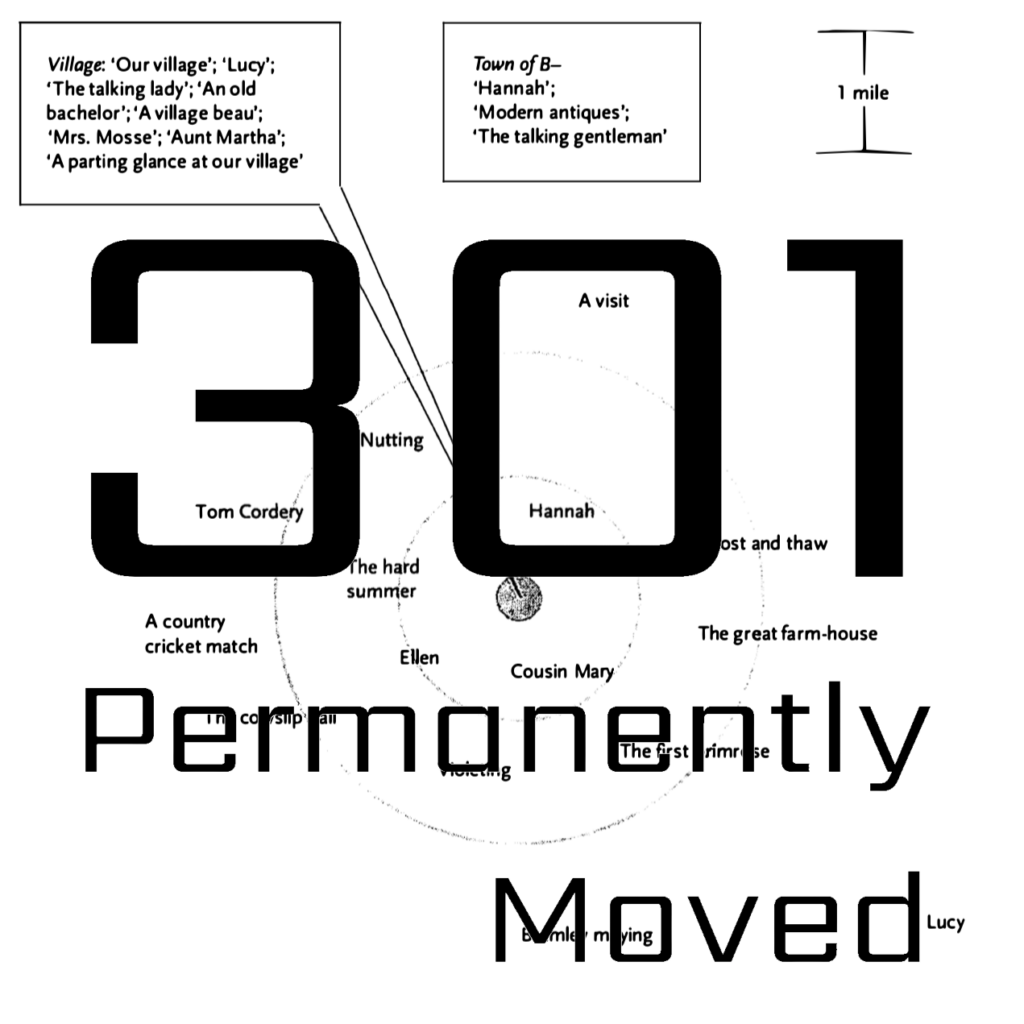
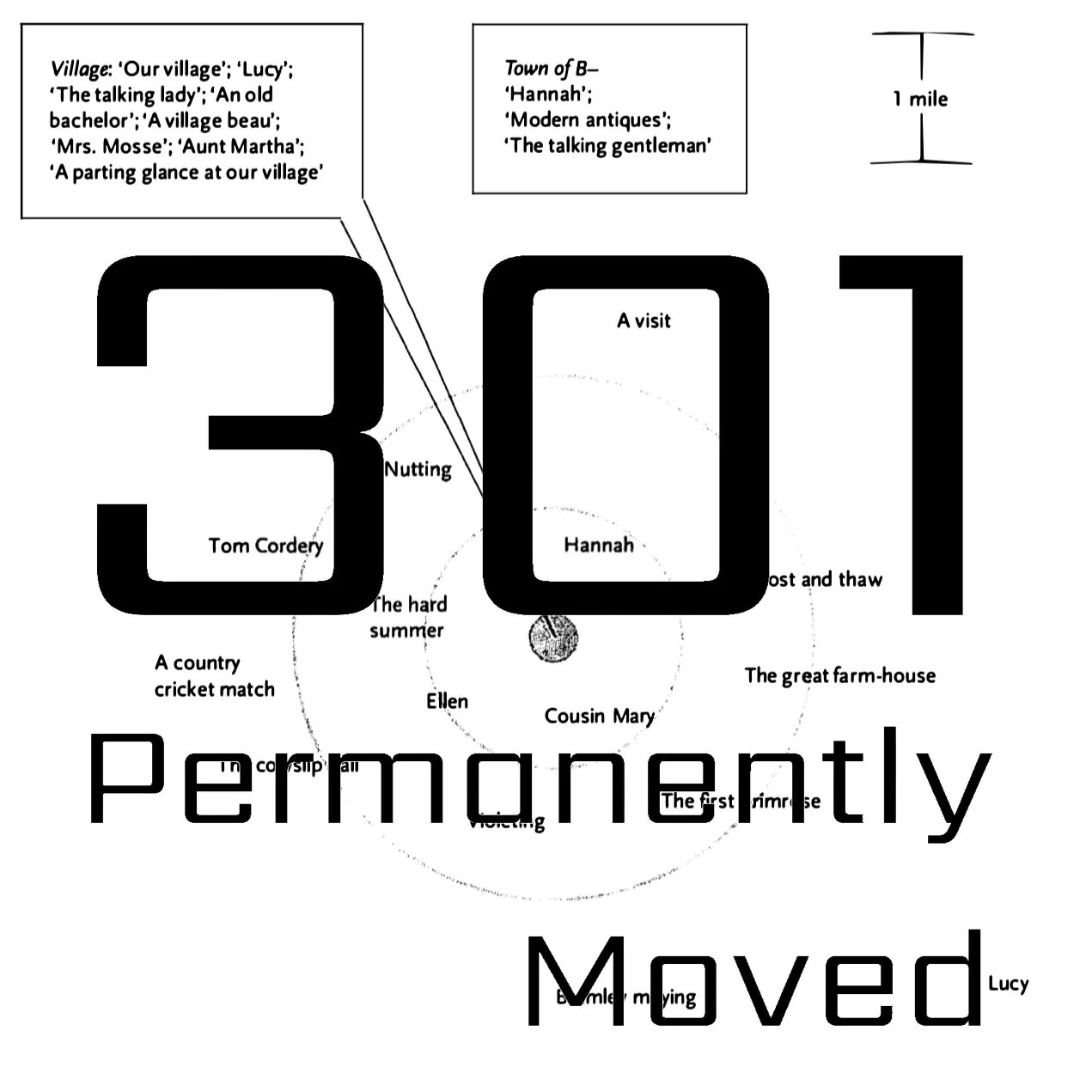
Circular geography, as a model, features heavily in Franco Moretti’s 2005 book, Graph, Maps and Trees, particularly maps.
Using this circular geographic model, he maps out the characters, concerns, and places. In Mary Mitford’s Our Village, published in five volumes between 1824 and 1833. It is, of course, set in a real place, Three Male Cross in Berkshire. So he also has geographic maps of the area to compare and contrast the types of geographies.
If you can imagine a map with three concentric circles, the dot in the center consists of the stories that are set in the heart of the village. The second focuses largely on personal relationships. And the third emphasizes more natural spectacles within the landscape. I think anyone can draw one of these circular geographies You’re home in the center, your friends, relationships, and job in the next ring out, and then lastly destinations and special trips that you make.
Of course, you always return to the center. Of course, even linear geography can be problematized. Think about the road that you walk down when you leave your house, and then imagine walking home again. And the question that you have to ask yourself is, are you walking in two different directions, up and down the same road, Or are you walking in the same direction down two different roads?
Anyway, thanks for listening and hope to speak to you again next week.
Permanently Moved
Permanently Moved is a 301-second personal podcast, written, recorded, and edited by @thejaymo.