

I’ve been talking recently in a group chat of bloggers and website owners about the nature of having an online identity in the post-peak social world we find ourselves in. The social landscape is changing, and that also means there are opportunities to rethink the ‘role of the homepage.’
A couple of years ago, I wrote about How I Use the Web, and How and Where You Can Follow Me which now needs an update as I’ve decided to make some changes to the underlying infrastructure of my online presence:
Bringing It Home
I recently read Mandy Brown’s brilliant piece, Coming Home, over at A Working Library, where she talks about the importance of having a homepage and writing a blog. Two lines really stood out:
The first is about the importance of things being located within a body of work:
Writing on my own site has very different affordances: I’m not typing into a little box, but writing in a text file. I’m not surrounded by other people’s thinking, but located within my own body of work.
And the second is about the context of that location:
While one of the reasons oft declared for using POSSE is the ability to own your content, I’m less interested in ownership than I am in context.
For a long time, I’ve been scattered across platforms, apps, and social networks. This sense of fragmentation got me thinking: What if I brought everything back to a central hub? Tracy Durnell’s blog / homepage is somewhat of an inspiration here—it’s very comprehensive, as is Brown’s aforementioned A Working Library. That’s where the idea of taking ownership over context rather than just content came from. It’s not about hosting your material everywhere, but about how it all connects.
This gathering process led me to create two new subdomains, each designed to bring ‘parts of me’ home.
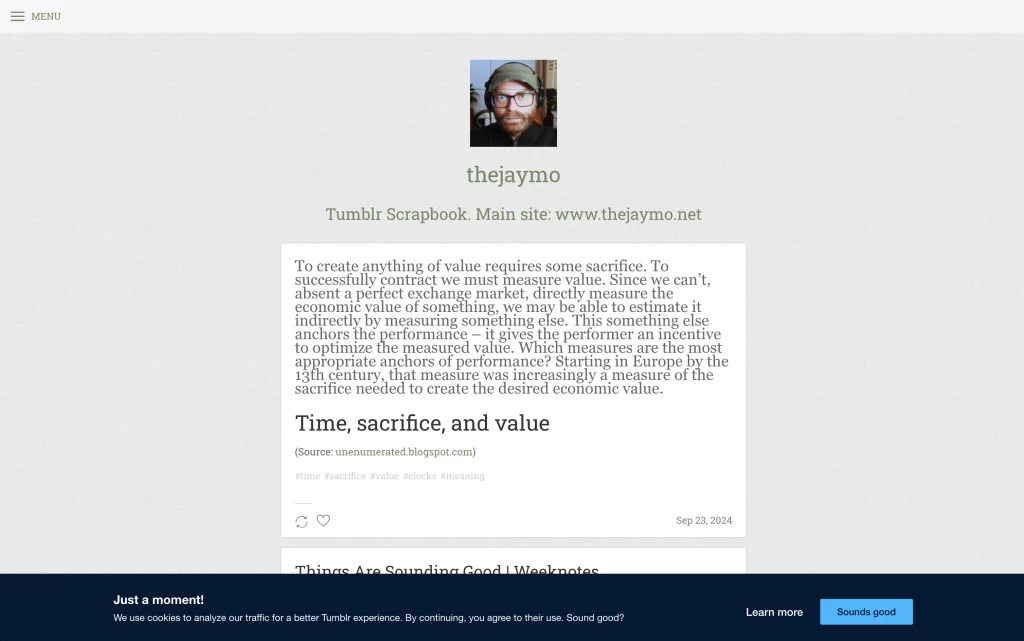
tumblr.thejaymo.net
The first act of this ‘gathering’ has been to re-house my personal Tumblr at tumblr.thejaymo.net.
I love Tumblr, and honestly, it’s my favourite social network. This move wasn’t about “owning” my Tumblr content—I could do that anywhere—but it was about creating the right environment for that content within the broader context of who I am online and this blog.
I still want to participate in Tumblr’s network, but by bringing my profile there under my own domain, I’m reclaiming the context just a little bit.
You can now follow my Tumblr from that URL and add it to your RSS readers if you like.
links.thejaymo.net
The second is a more significant change. I’ve made the decision to move away from pinboard.in as my primary bookmarking tool – despite being paid up there until 2034! After trying out several services, I’ve settled on raindrop.io as my new service of choice.
Since Dipping the Stacks is one of the most popular parts of my Weeknotes, I thought I should do a little more with it. For a long time, I’ve had a firehose link blog (the RSS feed from my Pinboard), so it made sense to turn this into more of ‘a thing.’
I’ve been following Jason Kottke and Andy Baio for the best part of 20 years. Link blogging has a long and venerable tradition, and I’d like to join in. So I’ve created the subdomain: links.thejaymo.net.
The webpage itself should update twice a day, displaying my most recent bookmarks. However, there’s a bit of magic that happens when you subscribe to the full RSS link feed at links.thejaymo.net/feed – you get my Raindrop.io XML.
To make this work, I had ChatGPT write some Cloudflare Worker code. (For those unfamiliar, Cloudflare Workers are scripts that run on Cloudflare’s servers, allowing you to handle data like web traffic or APIs without needing your own server.) In this case, the script pulls my Raindrop.io RSS/XML feed and directs it to thejaymo.net’s links subdomain. I’m just running it in production with no idea if it’s well-written or not—lol.
This means that if I ever decide to move to another bookmarking tool, I can just update my Worker script, and subscribers won’t notice any disruption. In essence, I’ve made myself my own middleman.
I would appreciate it if those of you who previously subscribed to my full-fat Pinboard RSS feed would make the leap to links.thejaymo.net so I can check my logs and debug a few things!! Please let me know if you do subscribe, and which reader you use. Thanks!
If this doesn’t pan out, I’ll consider using some kind of syndication plugin and blogging each of my bookmarks as pages on the subdomain blog and revert back to the native WordPress RSS—but we’ll see!

Owning Context, Not Just Content
I recently built thejaymo.info which returns a super-snappy ‘link in bio’ style page—rather than using some external service. It makes me wonder: What else can I move into or under my own domain?
Owning the context seems like something that other bloggers and indieweb folks can explore, especially as more and more people are feeling fragmented by today’s social platforms. In the age of algorithm-driven feeds, reclaiming your online identity—where you decide how your content is framed and displayed—gives us back a sense of control. By reclaiming the context, I’m deciding how my content lives and breathes online. It’s not just about ‘owning’ the material itself but shaping the environment it’s in. Context influences how people perceive your work, and owning that context means aligning it with your voice, ethos, and values—without any interference.
This reflects the ethos of the decentralized web—using tools and technologies to keep things open, interoperable, and within my control.
I’m trying to take practical steps to gather everything together—social media or link-sharing—whilst still having a unified hub. It also preserves a sense of web independence—whatever that means in today’s fragmented online world—but it feels like the right move. There’s value in bringing it all home.
If you’ve been though the process of consolidating or rethinking your own online presence, I’d love to hear how you’re approaching it—what tools have worked for you and what have you brought home?