Piss-yellow noon.
Carpet damp with old breath.
A hallway repeats itself.
The exit forgets you.
The Backrooms as Permissive IP
A lot has been written about the commercial success of Backrooms in the last week: a movie by a 20-year-old director, shot when he was 19, which has become A24’s highest-grossing opening film.
I criticise the cultural platform logic of equating financial success with artistic merit in Slop Machines (It’s nearly finished I promise), but it’s obvious why Backrooms success has become a mirror to Disney’s latest attempt to frack the last of the nostalgium out of the Star Wars franchise.
I think what’s more interesting is Backrooms as a cultural and media phenomenon. Over the last few years, my work on worlds, world-building, and online culture means I have opinions from which to step back and look at it more broadly.
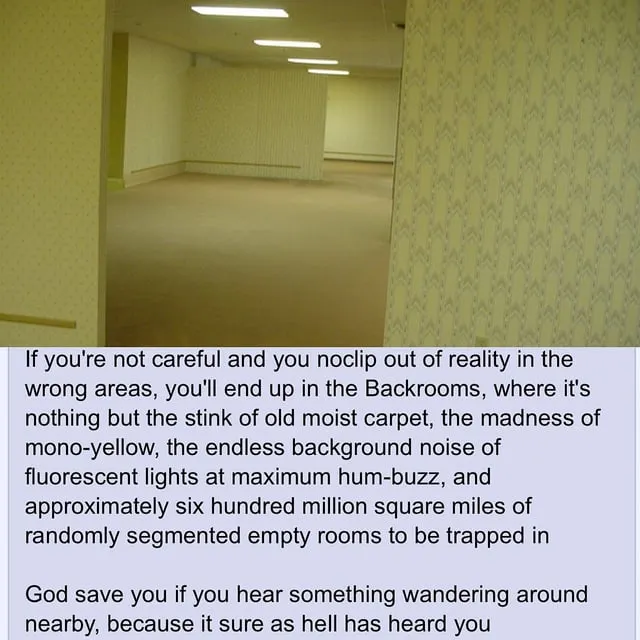
Beginning life on 4chan in 2019 with the pairing of an image and another anonymous comment, The Backrooms formed the basis for a cultural blooming: an emergent, post-commodity story world. A kind of cultural myth-object, completely outside the logic and control of the of legacy 20th Century cultural stack.
It’s the clearest example of the sort of thing I was talking about when I wrote about Permissive IPs back in 2020.
The Backrooms almost immediately blossomed into a vast sprawl of wikis, video games, and communities of people engaging with, and expanding the world.
There is the Backrooms Wikidot, which is probably the closest thing to the “literary” Backrooms, with the community world building out levels, entities, objects, phenomena, and multiple competing canons. There is also the Backrooms Fandom wiki, which has its own flavour of lore. There are Reddit communities posting collecting photos of liminal spaces that feel like the Backrooms; imageboards, YouTube creators, Minecraft maps, Garry’s Mod maps and much more.
Then there are the games. Escape the Backrooms (2022), Inside the Backrooms (2022), Backrooms: Lost Tape (2022), The Backrooms 1998 (2022), Enter the Backrooms (2021), and dozens of smaller horror experiments on Steam and itch.io.
None of these games are “official” in any meaningful sense, at least now as we understand officiality through the logic of late 20th Century franchise media. They are all products of different people picking up the myth-object and turning it around, and producing folk art about it.
The Movie Is Downstream From The Folk Art
This expansion of The Backrooms as a piece of mindshare in the cultural sphere is entirely dependent on another case I’ve written about: world literacy.
Audiences now arrive at a media franchise already knowing how worlds work. Not that world, specially, but worlds in general. Audiences have a new fluency, with expectations and a set of standards they didn’t consciously acquire, and they can’t necessarily articulate if asked. They got them from everywhere else. This is quite new. And if you are running a world, it’s one of the most important things to understand about the room you are walking into.
Audiences now arrive with expectations around the grammar of a world. They understand that a story is often just a window onto a larger implied reality, and they brought knowing how to already “read the world” all of this to The Backrooms.
The important thing is that The Backrooms is a collective idea, a piece of modern folklore which, much like earlier online bloomings of this phenomenon like Slenderman, immediately generates folk art.
The key point is that The Backrooms is a permissive entity within the mindshare of franchise media. An immediately understandable reality. An immediately understandable fiction. A door into a pre-existing, previously uncharted location in our collective cultural vector space.
One of the important learnings is that the world of the Backrooms is a “place”. Or rather, it is the minimum viable location. Yellow wallpaper, carpet, buzzing lights, and the sense that something has gone wrong with the structure of reality. Is all that’s needed for an audience with a high degree of world literacy to begin inferring the rest.
Backrooms (2026)
Kane Parsons, the director of A24’s Backrooms, released the first version of his own particular Backrooms universe on YouTube at the age of 16. It was an enormously successful piece of media made almost entirely in the open source software tool Blender.
If you have ever asked yourself what you would have done during the pandemic if you had been 14 years old, the answer for Parsons was: download Blender and filmmaking tutorials from YouTube directly into your brain. Two years later, this culminated in the following film on his channel Kane Pixels:
If you haven’t seen it, it’s worth watching. You can immediately see from its execution why producers at A24 immediately reached out about developing a feature-length version with him.
Because The Backrooms is a Permissive IP, Parsons did not need to own the whole thing in order to make a world inside it. With The Backrooms (Found Footage) parsons created his own branch of the world of The Backrooms. Developing its lore with: research footage, government or corporate experiments, missing persons, and institutional dread and intrigue, are all part of his particular interpretation of the world.
Even with the movie Pearsons hasn’t created ‘the whole’ of The Backrooms. He has created a Backrooms. A very successful Backrooms. And whilst the movie is now in theatres with institutional backing, it still sits inside a wider field of folk production.
I think what Hollywood is going to take away from the success of the movie is the wrong thing entirely. They will look at The Backrooms and see “IP”, commodity franchise dollar signs, instead of recognising a cultural object whose value emerged from permission, participation, and the absence of a single canonical owner.
Bedroom Tools
In 2021, I was working with Rival on the strategy for a large-scale, multi-use, permanent home in West Berlin for an art x technology foundation. During that period, and ever since, I have been trying to get my Millennial and Gen X peers, especially those standing at the gates of cultural institutions, to understand that this kind of “folk art” is the future.
In fact I remember saying something to the effect of, “right now in their bedroom a 14 year old is using a game engine to create a super important cultural artefact.” and they were!
In addition to world literacy, we also have to talk about ‘digital literacy’ and what it even means in the mid to late 2020’s.
When I went to university in 2003 my welcome pack included a quick start guide on how to use Microsoft’s Office Suite and step by step instructions on how to access my university email. Digital literacy meant a familiarity with a set of common programs: word processing, spreadsheets, PowerPoint, etc.
My university machine was my first ‘personal computer’ not shared with my family. Some of my flatmates arrived at university without a computer at all, and had to use the library’s computer labs to write all their assignments until their next loan came through.
Nevertheless we all arrived with a baseline familiarity with these tools required of us for digital literacy in the early 00’s. In fact, the first six weeks of my first year music and technology module consisted of an extremely boring introduction to DAWs. The course was designed in 2000, for students arriving having never used a DAW in their lives. Whereas I arrived being ‘literate’ in Logic, Cubase, FruityLoops, and trackers, hardware interfaces etc.
In the mid-2020s, there is now an entire generation, exemplified by people like Kane Parsons, at the lower end of Gen Z and the upper cohort of the emerging Generation Alpha, who have a comprehensive grasp not just of word processors and spreadsheets, but of game engines and 3D modelling software.
Perhaps they were never formally taught these tools, but they have ambiently absorbed them through daily life: Blender, Roblox, Fortnite Creator, Minecraft, YouTube tutorials, Discord servers, lore videos, modding communities. They also have a highly developed sense of spatial aesthetics and arrangement, developed by spending time inside virtual worlds.
Yes, my Millennial manager friends will moan in the pub about young people straight out of university arriving into the workplace without a clue about how shared drives, folder structures, and SharePoint work. But there is an entire cohort of people in the workplace who have a deep familiarity with video editing, audio editing, 3D modelling software, game engines, spatial composition, sound design, meme formats, lore videos, and publishing.
There is a much wider argument to be made here, and is my contribution to The Culture Stack, but I think the point is made, and Kane Parsons is basically my go-to high-profile example of this phenomenon.
I won’t romanticise it though, there are plenty of young people who are bad with computers, just as there are plenty of people in general who are bad with computers. Email, and SharePoint will always remain obscure occult systems to many of them. But there is also a generation of people who have grown up inside a much broader media tooling environment. They know what a render is. They know what a editing timeline is. They know what an asset is and what a game engine does. And via fandom they know how lore can be collectively made, uploaded, discussed, and iterated.
This interview with Backrooms millennial cinematographer is really interesting to hear how much he learnt from Parsons about using Blender. The whole film was pre-vis’d in Blender, lots of camera tests and experiments done virtually, the world was then exported to CAD software the the sets were designed and constructed. The source of knowledge however was always the blender file.
The success of The Backrooms film points to an audience who interacted with, contributed to, or thought about the Backrooms in the context of it being a Permissive IP. The success of the commercial media is downstream from the folk art.
Protocal Art
Mat Dryhurst and Holly Herndon are currently out there in the media mines trying to explain Protocol Art to people. In its shortest form based on my understanding: art made by designing the conditions under which culture happens.
Which is exactly what Permissive IPs cohere into as well. They are not just “open franchises”. They are intellectual protocols: cultural objects that establish the conditions under which folk production can occur at scale. Objects people can pick up and use to generate more culture. Like Solarpunk as memetic engine.
The anonymous person who posted that image on 4chan in 2019 almost certainly wasn’t thinking about any of this. Nor was the person who wrote the reply. But together, they set the conditions under which a world could unfold. Hollywood can’t buy or replicate this under the conditions of 100 years of copyright inertia and media commodity thinking.
This doesn’t mean Permissive IPs can’t be designed, managed, or stewarded. They absolutely can. That is the work of world runners. People who understand that the value of the world is not held in a single canonical text, but in the ongoing conditions that allow others to enter, contribute, elaborate, and make more culture.
A world runner does not ask: how do we control this?
They ask: what does this world need in order to keep unfolding?
Experience.Computer– Van Neistat

Van Neistat – Experience.Computer
IN THIS EPISODE
Jay Springett and first-generation digital filmmaker and artist Van Neistat explore the mind’s eye as an editing bay and cinematic “hard cuts” in the imagination. Then they discuss: text and video as physical raw material, setting creative boundaries with AI, and consider the YouTube algorithm as ultimately just a mirror of ourselves.
Also in this episode:
Typewriters, ribbon ink, and treating text as a physical raw material
Why traditional cinema is Formula One, but is YouTube professional skateboarding
Visualising to find lost items in physical space
The “good enough” threshold and Tom Sachs’ Crusty Seal of Approval
It was a real pleasure to meet and speak with Van! please do give it a listen!
On The Blog
May 2026 | Photo 365
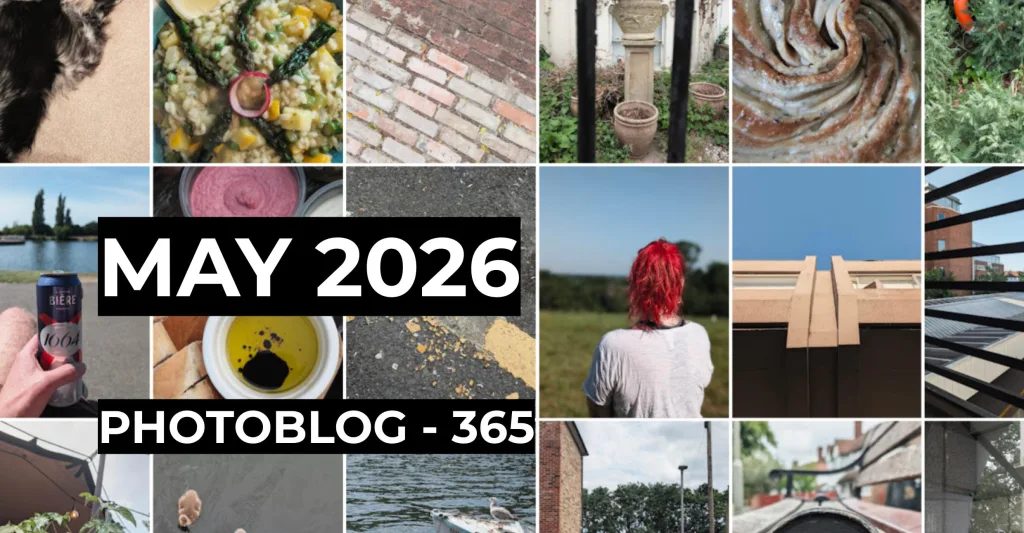
Photo 365 2026. Year 5, Month 5. Photo-a-day for the month of May 2026.

Subscribing to SSRZ supports my online work and creative projects.
As a thank you, I send you my zine four times a year, just like it’s 1994.
No spam. No email. Cancel at any time.
Photo 365

The Ministry Of My Own Labour
- Lunch with Bobby Fishkin from Crowddoing
- Long call catching up with BV about his Venice Biennale successes.
- I edited next episode of the podcast end to end!
- Had a call with a financial adviser
- Call about Liquid UX
- Spreadsheets and projections for one of the orgs I advise.
Terminal Access
I normally post something thats come out recently that I feel is timeline. But Venkat’s 2025 piece “Welcome to the Cosmopolis” has been doing the rounds again, it’s popped up in several group chats, and finally this week I read it properly.
It’s a really chewy piece and unlocked something for me, that I’ve been thinking about but been unable to articulate. Worth reading if you haven’t come across it already!
The element of design enters a cosmopolis as a functionally narrow but composable unit of behavioral logic, the protocol. The architecture of a cosmopolis is a result of a vast number of protocol-design decisions made around a powerful new core technology.
Protocols exist within the territorial logic of nation states and network logic of metropolises too, of course, but they are constitutive in the case of cosmopolises.
In other news RIP John Blanche
Dipping the Stacks
Slop is a kind of genius: Midwit savants and wildly successful literary mediocrity
Slop is its own form of genius… What’s actually happening, in my view, is something akin to a deep intuitive understanding of maximally-appealing narrative architectures. If you analyze one of these books on a sentence-by-sentence level, you’ll miss the emergent metastructure of the story.
By the Power of Mattel: How He-Man Was Created and Became a 1980s Icon – Serpentor’s Lair
Even the character’s story was engineered with toy shelves in mind. Early He-Man figures came packaged with mini-comics that introduced the world of Eternia, Castle Grayskull, and villainous Skeletor. These short stories weren’t just entertainment—they were a clever way to give kids a mythology quickly, without needing a movie or TV show first. Mattel essentially used the packaging to build lore, turning each purchase into a chapter of a larger saga. The name “He-Man” itself was blunt but memorable, perfectly fitting a toy designed to be instantly understood by a child scanning an aisle.
Alan Moore: ‘The comics industry is poisonous’
I had an urge to investigate shadowy London, the horse tipsters, gangsters, record producers and other lowlife characters. I’ve created a narrative that could include them, which collides happily with the idea of another London hidden behind our own. There’s a wonderful short story called N by Arthur Machen that suggested our London was a flimsy curtain hung before a blazing, eternal paradisal London.
Do we need more ‘aluminum-standard’ evidence?
An aluminium-standard approach can come with more caveats and uncertainties, but it shows that progress can still be made by thinking through the underlying processes behind the outcome we’re interested in. As Chris Whitty once put it: ‘An 80% right paper before a policy decision is made is worth ten 95% right papers afterwards, provided the methodological limitations imposed by doing it fast are made clear’.
Researchers Unveil Groundbreaking Sustainable Solution to Vitamin B12 Deficiency
Scientists have engineered Spirulina to produce active vitamin B12—once thought to exist only in animal products—creating a sustainable, carbon-neutral alternative to meat and dairy.
Reading
I picked up Duncan Barford of Occult experiments in the home/Baptists Head fame’s first novel The Going Down.
When longtime friends Bailey and Steve perform a final ritual in a house they once shared, the dead and the underworld haunt their lives and challenge their friendship. And when Steve’s girlfriend is drawn in, a dark secret binding Bailey finally comes to light.
Expertly written, The Going Down is not just a work of beautiful fiction but also a transformative work of magical dreaming.
“Magical dreaming” is very much the operative description. Fantastic book. I’m enjoying it so so much. Never read anything like it.
Music
JYOCHO’s – Singles 26 (EP)
Aside from listening the shit out of last years Headache album *again*. This week I spent a lot of time with Japanese math rock masters JYOCHO‘s new EP collecting the last year or so of singles.
My favourite single on the EP is Strong Body.
Remember Kids:
It is impossible to be proud of our intelligence at the moment when we are really exercising it.
Gravity and Grace – Simone Weil
Newsletter 📨
Subscribe to the mailing list and get my weeknotes and latest podcast episodes, sent directly to your inbox

Leave a Reply