
Hot on the heels of reaching one thousand consecutive days of my photo-a-day project comes another big life milestone.
I Have Reached Enlightenment
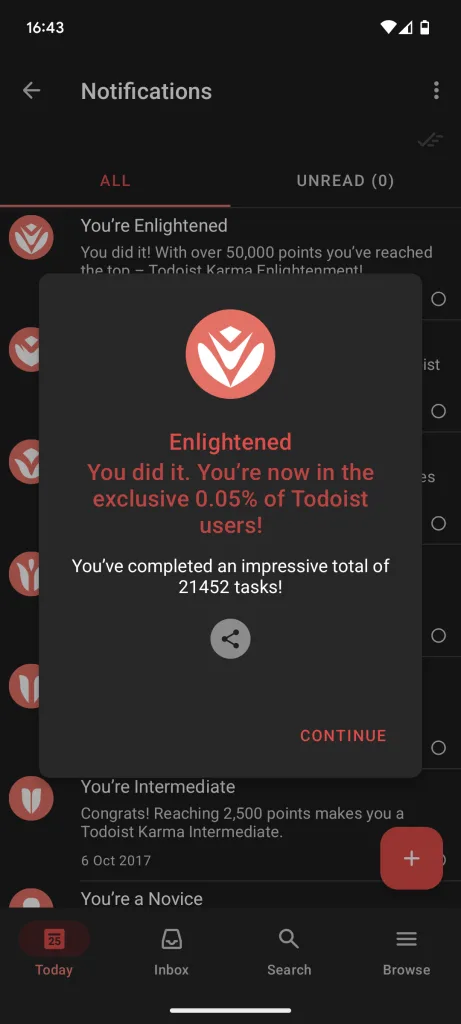
Not in my spiritual practice—I’d never be so bold! Instead, I’ve achieved the top ‘Karma’ level in my to-do list app: Todoist. Aptly named “Enlightenment,” it’s a milestone I wasn’t necessarily chasing, but here we are.
So, you can all go home now. I’ve done all the things that need doing – there’s nothing left to do.
Todoist
Todoist ‘karma’ is a gamified part of the app that rewards users with points for completing tasks, meeting daily or weekly goals, maintaining productivity streaks, etc. As you accumulate points, you progress through different levels, providing a simple way to track productivity over time.
The congratulatory email said that ‘Enlightenment’ is an achievement unlocked by only 0.05% of users, so I guess I’m in rarefied air now.
I’ve written plenty of times about how lists define my life.
But Todoist entered the picture during my mid-twenties after I read Getting Things Done—a book that changed my life. Back then, the job I was in had strict software installation policies, so Todoist’s browser extension became my go-to for organising my chaotic work life. I can’t remember the exact date I signed up (it was with an email I no longer have access to), but it was way before their 2015 rebrand, so it’s been a long journey.
Looking back, my Todoist usage maps neatly to my personal and professional growth. I leaned on it during my tech consultancy job, where the overwhelming workload pushed me to seek structure. Later, it became a vital tool as I transitioned into project management and then operations. I’ve joked that my Todoist is probably the most organized part of the high-growth startups I’ve worked at.
When I quit all that and went freelance, however, I entered what I call my “wilderness years” with Todoist. During that time, I started using Notion for everything, especially around the start of 2020. I even recommended it to some friends at the company Yaya, when they were all hitting the limits of what Todoist could do for small teams. But back then, Notion wasn’t quite ready to replace Todoist for task management, at least not in a way that felt right for them.
During the lockdown, I leaned on Notion for managing my projects and writing, but over time, I’ve found its UX for project management… cumbersome. So, I returned to Todoist for my organization. Most productivity software, including Notion and Todoist, is built on the foundations of Getting Things Done so witching is always easy. What I appreciate most about Todoist is that it simplifies the process and doesn’t try to overcomplicate things with unnecessary features.
Todoist has since then remained a constant in my life. Even as other apps and systems have come and gone. I just think it’s the best productivity apps for simple task management. Which is why I always find my way back to it.
In fact, I’ve come to see people constantly switching from one productivity app to another in search of the ‘perfect app’ as a kind of advanced procrastination. Setting up productive apps from scratch has become a hobby for some people—as shown by the vast “grindset” industry on YouTube. I sometimes wonder if the audience for all that content ever gets things done.
Speaking of getting things done, here’s the one core truth I can impart from my enlightened position:
If It’s Not Written Down, It Doesn’t Exist.
This principle is at the heart of GTD and is fundamental to countless other productivity frameworks and apps. The idea is simple: get everything out of your head so you free up mental space for more creative or critical thinking. I don’t particularly like the term ‘second brain,’ but if it works for you, think of it that way. Once it’s written down, you don’t have to stress about remembering the details—you’ve offloaded that onto a system you trust.
Years ago now, I wrote about being a “notebook and a list” guy. Which is why Todoist resonates with me so strongly—I simply love lists. There’s something uniquely satisfying about crossing tasks off. Other systems, like Kanban or more visual tools, are fine, but none provide the same satisfaction as a simple tick in a box.
One of my favorite features of Todoist is recurring tasks. For things I need to remember every week, month, or year, I just set it once, and Todoist handles the rest. It’s a small feature, but it’s a game changer for keeping my life organized without cluttering my brain.
I keep several top-level projects in Todoist, aligned with the yearly themes or vectors I set at the beginning of each year. Sub-projects may lay dormant for months until they suddenly become relevant again—like the ones for holidays or special occasions. Every Wednesday, I review my tasks in Todoist to see what’s left to complete by the end of the week and what can be carried forward. Without this habit, I’d lose track of everything I need to do given my naturally chaotic tendencies.
The karma system has been motivating too. I might in fact email Todoist and ask if they can reset my Karma—starting again might add a fresh challenge.
One of the things I appreciate most about Todoist is its slow and steady development pace. Unlike other apps that rush to release new features, Todoist focuses on meaningful quality-of-life improvements—sometimes for months and years at a stretch.
I’ve been part of their beta program for a long time now and have seen firsthand how the app evolves based on user feedback. Small tweaks, intuitive improvements, and user-friendly polish are the hallmarks of Todoist’s development approach. Several times, I’ve sent feedback and found the behaviour in the app changed a week later—super cool.
If you’ve found this post while researching Todoist reviews, give it a try. It works for me, and I think it could work for you too. But whether or not you use Todoist, my one piece of grindset advice, coming from my so-called state of Enlightenment, is this:
If it’s not written down, it doesn’t exist.
Start Select Reset 📑
Subscribing to SSRZ supports my online work and creative projects.
As a thank you, I send you my zine four times a year, just like it’s 1994.